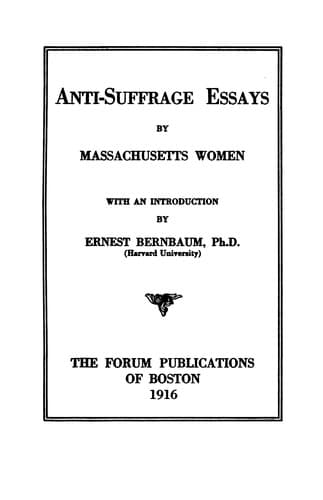
Women -- Massachusetts; Women -- Suffrage -- United States; Women's Anti-Suffrage Association of Massachusetts
The help of all good women is now at the service of the men who have the
nations' welfare at heart, nor are they hampered by the interference of
the less good as they must be when the vote of the best might be
nullified by the vote of the worst.
We beg the men not to be deceived by the noise and clatter of a few paid
professional agitators, supported by misguided enthusiasts whose hearts
are larger than their heads; and we ask the men to help us to uphold the
womanhood of woman with all its responsibilities, its ideals, and its
spiritual endowment.
X
SUFFRAGE AND THE SCHOOL TEACHER
ELIZABETH JACKSON
_Elizabeth Jackson graduated from the Bridgewater High School
in 1908, from the Bridgewater State Normal School in 1910, from
Radcliffe College A. B. (Summa cum laude) 1913, A. M. 1914; is a
candidate for the degree of Ph. D.; treasurer of Radcliffe Chapter
of Phi Beta Kappa 1914-16; President of the Radcliffe Graduates'
Club, 1915-16._
_J. A. H._
An essential weakness in the suffrage argument is the failure to
distinguish between government and culture, the functions and the
instruments of each. Government is an organization for compelling one
portion of the community to do the will of another portion. In a
democracy, the minority is forced to obey the majority. The fundamental
idea is compulsion, a thing not lovely in theory and frequently unlovely
in practice. The golden haze that surrounds the dream of ideal democracy
is dissipated by contact with any given city ward. The machinery of
government is a matter of stress and strain; of selfishness, cruelty,
and hate, at the worst; at best, of conflicting interest, mutual
incomprehension, and maddening friction. When we refer to good
government, we may mean either of two things. We may perhaps describe a
community where the majority is notably successful in imposing its will
on the minority so that laws are strictly enforced and scrupulously
obeyed. In my experience, this is not the sense in which the suffragist
uses the phrase. Woman suffrage is not advertised as a means of
producing a more tractable minority. On the contrary, as Mr. Taft has
pointed out, the suffrage movement is a conspicuous instance of one
great menace of the age, the unwillingness of minorities to abide by the
best judgment of the state as a whole. Again, the campaign orator does
not assure the Maine audience that under equal suffrage statewide
prohibition, instituted by male voters, will become a fact instead of a
joke; no speaker in our home town has informed us that woman's vote will
wipe out the saloons that defy the "no" of the March meeting. Rather, as
I understand it, the "good government" which the suffragist promises to
inaugurate consists of improved legislation along certain specific
lines. That is to say, she promises not that the laws will be better
enforced, but that they will be different. A community's predilection
Public-domain text, read in full here on John Shaqi.
Reviews
Reviews
No reviews yet
Be the first to share your thoughts on this work.
Join the Discussion
Join the discussion
Sign in to leave a comment or review.
Sign InorCreate an account