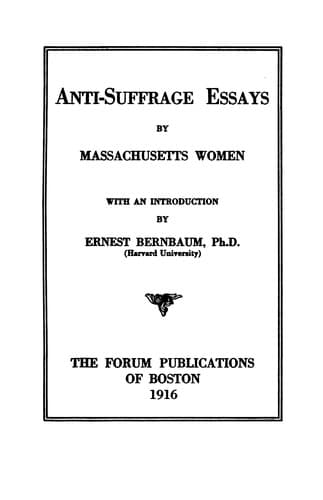
Women -- Massachusetts; Women -- Suffrage -- United States; Women's Anti-Suffrage Association of Massachusetts
for good laws or bad, however, depends not on government but on
civilization. Public opinion is moulded by innumerable forces, of which
the home, the church, the newspaper, and the public school are merely
illustrations. In most if not all of these, women already play a
conspicuous part; through them they wield an incalculable power. The
confusion, unconscious or otherwise, of these forces of culture and the
forces of government, is one of the prime fallacies of the suffrage
position.
To make the true state of the case more clear, take a single
institution, the public school, with its various bearings on the
question of woman suffrage. Pass over the school committee vote which
only about two per cent of Massachusetts women regularly use, and
consider merely the power which the very nature of our school system
puts in women's hands. All the children in our primary grades, and all
but an infinitesimal fraction of those in the grammar grades, are taught
by women. The preponderance of woman teachers is nearly as great in the
high schools where, except in a few cities, men are employed for
administration and discipline and only secondarily for instruction. That
is to say, women and not men are shaping the minds of future voters
during the formative and decisive years. From women rather than men, our
children learn the elements of good citizenship,--respect for public
property, obedience to law, and the power of independent thought.
The degree to which the lesson is learned, depends upon two things;
namely, the quality of the teacher and the extent of her influence.
Accordingly, two questions arise. Would woman suffrage give us better
teachers? Would it increase the power which they already hold? One may
get some light on the first point by studying the placing of normal
school graduats. The connection between the schools and politics is
already lamentably close. Many districts, with administrations
predominantly of one party or religious sect choose first teachers of
that sect, good or bad, and sisters and daughters of voters of that
party; then enough women to complete the necessary number. Suppose that
the teacher, instead of being the daughter of the voter, holds the vote
herself. The evil would become universal. There is no indication that a
woman's salary and position under such circumstances be more directly
conditioned upon her abilities as a teacher. The chances are that woman
suffrage would tend to make the school more truly the servant of the
party in power than of the general good. Moreover, a vote can be used as
a commodity of exchange; and the woman-voter who amid the fluctuations
of city politics would protect her position by a shrewd use of her
ballot would hardly be the best school mistress of American youth.
Public-domain text, read in full here on John Shaqi.
Reviews
Reviews
No reviews yet
Be the first to share your thoughts on this work.
Join the Discussion
Join the discussion
Sign in to leave a comment or review.
Sign InorCreate an account