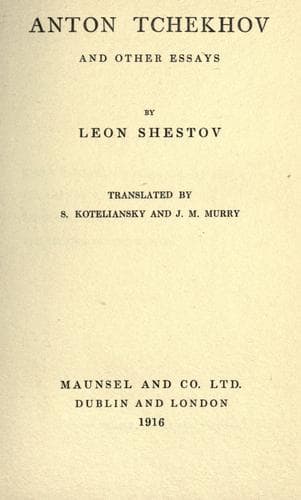
Chekhov, Anton Pavlovich, 1860-1904; Dostoyevsky, Fyodor, 1821-1881; Philosophy; Russian literature -- History and criticism
Spencer confidently asserts that, once he could not accept Kant's
fundamental proposition, he not only could not be a Kantian any more,
but he found it useless even to become further acquainted with Kant's
philosophy. That he did not become a Kantian is nothing to grieve over
--there are Kantians enough without him--but that he did not acquaint
himself with Kant's principal works, and above all with the whole
school that rose out of Kant, may be sincerely regretted. Perhaps, as
a new man, remote from Continental traditions, he would have made a
curious discovery, and would have convinced himself that it was not at
all necessary to accept the proposition of the subjectivity of space
and time in order to become a Kantian. And perhaps with the frankness
and simplicity peculiar to him, which is not afraid to be taken for
naïveté, he would have told us that not a single Kantian (Schopenhauer
excepted), not even Kant himself, has ever seriously accepted the
fundamental propositions of the Transcendental Aesthetic, and therefore
has never made from them any conclusions or deductions whatever. On
the contrary, the Transcendental Aesthetic was itself a deduction from
another proposition, that we have synthetic judgments _a priori._ The
original rôle of this, the most original of all theories ever invented,
was to be a support and an explanation of the mathematical sciences.
It had never had an independent, material content, susceptible of
analysis and investigation. Space and time are the eternal forms of our
perception of the world: to this, according to the strict meaning of
Kant's teaching, nothing can be added, and nothing abated. Spencer, not
having read the book to the end, imagined that Kant would begin to make
deductions and became nervous. But if he had read the book to the end,
he would have been convinced that Kant had not made any deductions, and
that the whole meaning of _The Critique of Pure Reason_ indeed is that
from the propositions of the Transcendental Aesthetic no deductions can
be made. It is now about a hundred and fifty years since _The Critique
of Pure Reason_ appeared. No philosophic work has been so much studied
and criticised. And yet where are the Kantians who attempt to make
deductions from the proposition as to the subjectivity of space and
time? Schopenhauer is the only exception. He indeed took the Kantian
idea seriously, but it may be said without exaggeration that of all
Kantians the least like Kant was Schopenhauer.
Public-domain text, read in full here on John Shaqi.
Reviews
Reviews
No reviews yet
Be the first to share your thoughts on this work.
Elsewhere in the archive
Join the Discussion
Join the discussion
Sign in to leave a comment or review.
Sign InorCreate an account