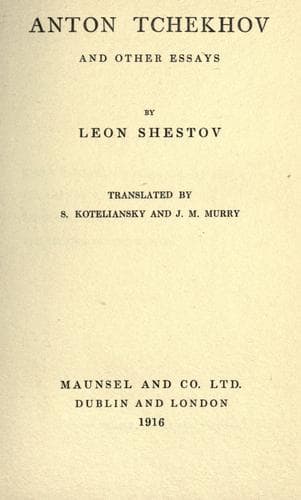
Chekhov, Anton Pavlovich, 1860-1904; Dostoyevsky, Fyodor, 1821-1881; Philosophy; Russian literature -- History and criticism
The world is a veil of Maia. Would Kant really have agreed to such
an interpretation of his Transcendental Aesthetic? Or what would
Kant have said, if he had heard that Schopenhauer, referring to the
same Aesthetic in which he saw the greatest philosophic revelation,
had admitted the possibility of clairvoyance and magic? Probably
Spencer thought that Kant would himself make all these deductions, and
therefore threw away the book which bound him to conclusions so absurd.
It is a pity that Spencer was in such a hurry. Had he acquainted
himself with Kant, he would have been convinced that the most absurd
idea might serve a very useful purpose; and that there is not the least
necessity to make from an idea all the deductions to which it may lead.
A man is a free agent and he can deduce if he has a mind to; if he has
not, he will not; and there is no necessity to judge the character
of a philosophic theory by its general postulates. Even Schopenhauer
did not exploit Kant's theory to the full, which, if it had really
divined the truths hitherto hidden from men, would have not only put
an end to metaphysical researches, but also have given an impulse and
a justification to perfectly new experiments which from the previous
standpoint were quite mad and unimaginable. For if space and time are
forms of our human perception, then they do indeed hide the ultimate
truth from us. While men knew nothing of this, and, simple minded,
accepted the visible reality for the actual real, they could not of
course dream of true knowledge. But from the moment when the truth was
revealed to them through Kant's penetration, it is clear that their
true task was to use every possible means to free themselves from
the harness and to break away from it, while consolidating all those
judgments which Kant calls synthetic judgments _a priori_ for all
eternity.
And the new, the critical metaphysics, which should take account of
the stupid situation in which these had hitherto found themselves who
saw in apodeictic judgments eternal truths, had a great task to set
herself: to get rid at all costs of apodeictic judgments, knowing them
for false. In other words, Kant's task should not have been to minimise
the destructive effect of Hume's scepticism, but to find a still more
deadly explosive to destroy even those limits which Hume was obliged
to preserve. It is surely evident that truth lies beyond synthetic
judgments _a priori,_ and that it cannot at all resemble an _a priori_
judgment, and in fact cannot be like a judgment of any kind.
Public-domain text, read in full here on John Shaqi.
Reviews
Reviews
No reviews yet
Be the first to share your thoughts on this work.
Elsewhere in the archive
Join the Discussion
Join the discussion
Sign in to leave a comment or review.
Sign InorCreate an account