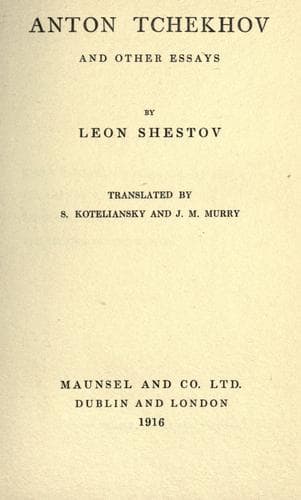
Chekhov, Anton Pavlovich, 1860-1904; Dostoyevsky, Fyodor, 1821-1881; Philosophy; Russian literature -- History and criticism
And not Natorp alone argues thus. It would be true to say all modern
philosophers, who are always contending with each other and suspecting
each other of 'eternal incapability.' Philosophers have not the same
means of compelling conviction as the representatives of other positive
sciences: they cannot force every one to undeniable conclusions. Their
_ultima ratio,_ their personal opinion, their private conviction,
their last refuge, is the 'eternal incapability' of their opponents to
understand them. Here the tragic dilemma is clear to all. Of two things
one: either renounce philosophy entirely, or allow that that which
Natorp calls the 'eternal incapability' is not a vice or a weakness,
but a great virtue and power hitherto unappreciated and misunderstood.
Aristotle, indeed, was organically incapable of understanding Plato,
just as Plato could not have understood Aristotle, just as neither of
them could understand the sceptics or the sophists, just as Leibnitz
could not understand Spinoza, as Schopenhauer could not understand
Hegel, and so on till our riotous modern days when no philosopher
can understand any one except himself. Besides, philosophers do not
aspire to mutual understanding and unity, but usually it is with the
utmost reluctance that they observe in themselves similarity to their
predecessors. When the similarity of Schopenhauer's teaching to that
of Spinoza was pointed out to him, he said _Pereant qui ante nos
nostra dixerint._ But representatives of the other positive sciences
understand each other, rarely dispute, and never argue by referring to
the 'eternal incapability' of their confrères. Perhaps in philosophy
this chaotic state of affairs and this unique argument are part of the
craft. Perhaps in this realm it is necessary that Aristotle should
not understand Plato and should not accept him, that the materialists
should always be at war with the idealists, the sceptics with the
dogmatists. In other words, the premiss with which Schopenhauer began
the investigation into the value of life, and which as we have shown he
took without verification from the representatives of positive science,
though perfectly applicable in its proper sphere, is quite out of place
in philosophy. And indeed, though they never speak of it, philosophers
value their own personal convictions much more highly than universally
valid truth. The impossibility of discovering one sole philosophic
truth may alarm any one but the philosophers themselves, who, so soon
as they have worked out their own convictions, take not the smallest
trouble to secure general recognition for them. They are only busy with
getting rid of their vassal dependence and acquiring sovereign rights
for themselves. The question whether there will be other sovereigns by
their side hardly concerns them at all.
Public-domain text, read in full here on John Shaqi.
Reviews
Reviews
No reviews yet
Be the first to share your thoughts on this work.
Elsewhere in the archive
Join the Discussion
Join the discussion
Sign in to leave a comment or review.
Sign InorCreate an account