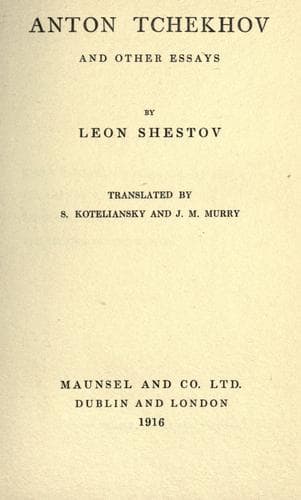
Chekhov, Anton Pavlovich, 1860-1904; Dostoyevsky, Fyodor, 1821-1881; Philosophy; Russian literature -- History and criticism
The history of philosophy should be so expounded that this tendency
should be clearly manifest. This would spare us from many prejudices,
and would clear the way for new and important inquiries. Kant, who
shared the opinion that truth is the same for all, was convinced that
metaphysics must be a science _a priori,_ and since it cannot be a
science _a priori,_ must therefore cease to exist. If the history
of philosophy had been expounded and understood differently in his
day, it would never have entered his mind thus to impugn the rights
of metaphysics. And probably he would not have been vexed by the
contradictoriness or the lack of proof in the teachings of various
schools of metaphysics. It cannot be otherwise, neither should it
be. The interest of mankind is not to put an end to the variety of
philosophic doctrines but to allow the perfectly natural phenomenon
wide and deep development. Philosophers have always had an instinctive
longing for this: that is why they are so troublesome to the historian
of philosophy.
_The First and the Last_
In the first volume of _Human, All too Human,_ which Nietzsche wrote
at the very beginning of his disease, when he was still far from
final victory and chiefly told of his defeats, there is the following
remarkable, though half-involuntary confession: 'The complete
irresponsibility of Man for his actions and his being is the bitterest
drop for the man of knowledge to drink, since he has been accustomed to
see in responsibility and duty the very patent of his title to manhood.'
Much bitterness has the inquiring spirit to swallow, but the bitterest
of all is in the knowledge that his moral qualities, his readiness to
fulfil his duty ungrudgingly, gives him no preference over other men.
He thought he was a man of noble rank, even a prince of the blood,
crowned with a crown, and the other men boorish peasantry--but he is
just the same, a peasant, the same as all the rest. His patent of
nobility was that for which he fulfilled his most arduous duty and made
sacrifices; in it he saw the meaning of life. And when it is suddenly
revealed that there is no provision made for titles or patents, it
is a horrible catastrophe, a cataclysm--and life loses all meaning.
Evidently the conviction expressed with such moving frankness in these
words, was with Nietzsche a second nature, which he could not master
all his life long. What is the Superman but a title, a patent, giving
the right to be called a noble among the _canaille?_ What is the pathos
of distance and all Nietzsche's teaching of ranks? The formula, beyond
good and evil, was by no means so all-destructive as at first sight it
seemed. On the contrary, by erasing certain laws graven on the tables
of mankind of old, that formula as it were revealed other commandments,
obliterated by time, and therefore invisible to many.
Public-domain text, read in full here on John Shaqi.
Reviews
Reviews
No reviews yet
Be the first to share your thoughts on this work.
Elsewhere in the archive
Join the Discussion
Join the discussion
Sign in to leave a comment or review.
Sign InorCreate an account