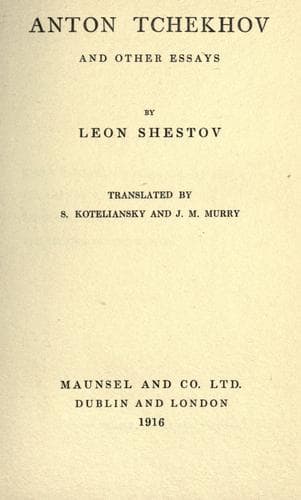
Chekhov, Anton Pavlovich, 1860-1904; Dostoyevsky, Fyodor, 1821-1881; Philosophy; Russian literature -- History and criticism
inability to bend the knee before that which educated people consider
holy as a defect against which he must struggle with all his strength.
And he does struggle with all his strength against this defect. But
not only is the struggle unavailing; the longer Tchekhov lives, the
weaker grows the power of lofty words over him, in spite of his own
reason and his conscious will. Finally, he frees himself entirely
from ideas of every kind, and loses even the notion of connection
between the happenings of life. Herein lies the most important and
original characteristic of his creation. Anticipating a little, I would
here point to his comedy, _The Sea-Gull,_ where, in defiance of all
literary principles, the basis of action appears to be not the logical
development of passions, or the inevitable connection between cause and
effect, but naked accident, ostentatiously nude. As one reads the play,
it seems at times that one has before one a copy of a newspaper with
an endless series of news paragraphs, heaped upon one another, without
order and without previous plan. Sovereign accident reigns everywhere
and in everything, this time boldly throwing the gauntlet to all
conceptions. In this, I repeat, is Tchekhov's greatest originality, and
this, strangely enough, is the source of his most bitter experiences.
He did not want to be original; he made super-human efforts to be
like everybody else: but there is no escaping one's destiny. How
many men, above all among writers, wear their fingers to the bone in
the effort to be unlike others, and yet they cannot shake themselves
free of _cliché_--yet Tchekhov was original against his will!
Evidently originality does not depend upon the readiness to proclaim
revolutionary opinions at all costs. The newest and boldest idea may
and often does appear tedious and vulgar. In order to become original,
instead of inventing an idea, one must achieve a difficult and painful
labour; and, since men avoid labour and suffering, the really new is
for the most part born in man against his will.
III
Public-domain text, read in full here on John Shaqi.
Reviews
Reviews
No reviews yet
Be the first to share your thoughts on this work.
Join the Discussion
Join the discussion
Sign in to leave a comment or review.
Sign InorCreate an account