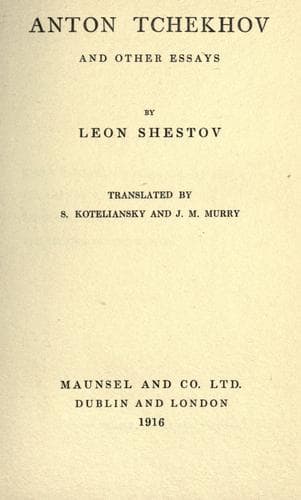
Chekhov, Anton Pavlovich, 1860-1904; Dostoyevsky, Fyodor, 1821-1881; Philosophy; Russian literature -- History and criticism
it is evident from Tolstoi's description of his life, is a mediocre,
average character, one of those men who pass through life avoiding
anything that is difficult or problematical, caring exclusively for the
calm and pleasantness of earthly existence. Hardly had the cold wind of
tragedy blown upon him, than he was utterly transformed. The story of
Ivan Ilyich in his last days is as deeply interesting as the life-story
of Socrates or Pascal.
In passing I would point out a fact which I consider of great
importance. In his work Tchekhov was influenced by Tolstoi, and
particularly by Tolstoi's later writings. It is important, because thus
a part of Tchekhov's 'guilt' falls upon the great writer of the Russian
land. I think that had there been no _Death of Ivan Ilyich,_ there
would have been no _Ivanov,_ and no _Tedious Story,_ nor many others
of Tchekhov's most remarkable works. But this by no means implies that
Tchekhov borrowed a single word from his great predecessor. Tchekhov
had enough material of his own: in that respect he needed no help. But
a young writer would hardly dare to come forward at his own risk with
the thoughts that make the content of _The Tedious Story._ When Tolstoi
wrote _The Death of Ivan Ilyich,_ he had behind him _War and Peace,
Anna Karenina,_ and the firmly established reputation of an artist of
the highest rank. All things were permitted to him. But Tchekhov was
a young man, whose literary baggage amounted in all to a few dozen
tiny stories, hidden in the pages of little known and uninfluential
papers. Had Tolstoi not paved the way, had Tolstoi not shown by his
example, that in literature it was permitted to tell the truth, to
tell everything, then perhaps Tchekhov would have had to struggle long
with himself before finding the courage of a public confession, even
though it took the form of stories. And even with Tolstoi before him,
how terribly did Tchekhov have to struggle with public opinion. 'Why
does he write his horrible stories and plays?' every one asked himself.
'Why does the writer systematically choose for his heroes situations
from which there is not, and cannot possibly be, any escape?' What
can be said in answer to the endless complaints of the old professor
and Katy, his pupil? This means that there is, essentially, something
to be said. From times immemorial, literature has accumulated a large
and varied store of all kinds of general ideas and conceptions,
material and metaphysical, to which the masters have recourse the
moment the over-exacting and over-restless human voice begins to be
heard. This is exactly the point. Tchekhov himself, a writer and an
educated man, refused in advance every possible consolation, material
or metaphysical. Not even in Tolstoi, who set no great store by
philosophical systems, will you find such keenly expressed disgust for
every kind of conceptions and ideas as in Tchekhov. He is well aware
that conceptions ought to be esteemed and respected, and he reckons his
Public-domain text, read in full here on John Shaqi.
Reviews
Reviews
No reviews yet
Be the first to share your thoughts on this work.
Join the Discussion
Join the discussion
Sign in to leave a comment or review.
Sign InorCreate an account