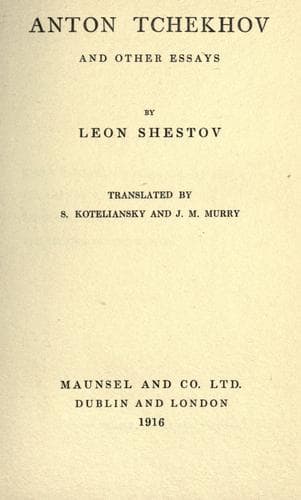
Chekhov, Anton Pavlovich, 1860-1904; Dostoyevsky, Fyodor, 1821-1881; Philosophy; Russian literature -- History and criticism
If the professor's 'new' thoughts and feelings shone bright with
beauty, nobility or heroism, the case would be different. The reader
could learn something from it. But Tchekhov's story shows that these
qualities belonged to his hero's old thoughts. Now that his illness has
begun, there has sprung up within him a revulsion from everything which
even remotely resembles a lofty feeling. When his pupil Katy turns to
him for advice what she should do, the famous scholar, the friend of
Pirogov, Kavelin and Nekrassov, who had taught so many generations
of young men, does not know what to answer. Absurdly he chooses from
his memory a whole series of pleasant-sounding words; but they have
lost all meaning for him. What answer shall he give? he asks himself.
'It is easy to say, Work, or divide your property among the poor, or
know yourself, and because it is easy, I do not know what to answer.'
Katy, still young, healthy and beautiful, has by Tchekhov's offices
fallen like the professor into a trap from which no human power can
deliver her. From the moment that she knew hopelessness, she had won
all the author's sympathy. While a person is settled to some work,
while he has a future of some kind before him, Tchekhov is utterly
indifferent to him. If he does describe him, then he usually does it
hastily and in a tone of scornful irony. But when he is entangled, and
so entangled that he cannot be disentangled by any means, then Tchekhov
begins to wake up. Colour, energy, creative force, inspiration make
their appearance. Therein perhaps lies the secret of his political
indifferentism. Notwithstanding all his distrust of projects for a
brighter future, Tchekhov like Dostoevsky was evidently not wholly
convinced that social reforms and social science were important.
However difficult the social question may be, still it may be solved.
Some day, perhaps people will so arrange themselves on the earth as
to live and die without suffering: further than that ideal humanity
cannot go. Perhaps the authors of stout volumes on Progress do guess
and foresee something. But just for that reason their work is alien to
Tchekhov. At first by instinct, then consciously, he was attracted to
problems which are by essence insoluble like that presented in _The
Tedious Story_: there you have helplessness, sickness, the prospect of
inevitable death, and no hope whatever to change the situation by a
hair. This infatuation, whether conscious or instinctive, clearly runs
counter to the demands of common sense and normal will. But there is
nothing else to expect from Tchekhov, an overstrained man. Every one
knows, or has heard, of hopelessness. On every side, before our very
eyes, are happening terrible and intolerable tragedies, and if every
doomed man were to raise such an awful alarm about his destruction as
Nicolai Stepanovich, life would become an inferno; Nicolai Stepanovich
must not cry his sufferings aloud over the world, but be careful to
Public-domain text, read in full here on John Shaqi.
Reviews
Reviews
No reviews yet
Be the first to share your thoughts on this work.
Join the Discussion
Join the discussion
Sign in to leave a comment or review.
Sign InorCreate an account