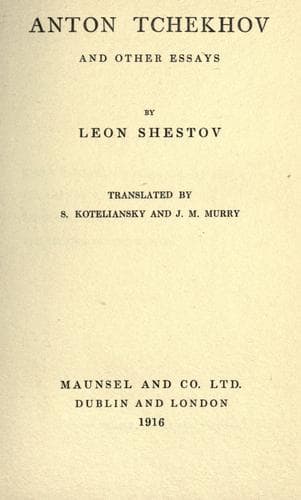
Chekhov, Anton Pavlovich, 1860-1904; Dostoyevsky, Fyodor, 1821-1881; Philosophy; Russian literature -- History and criticism
trouble people as little as possible. And Tchekhov should have assisted
this reputable endeavour by every means in his power. As though there
were not thousands of tedious stories in the world--they cannot be
counted! And above all stories of the kind that Tchekhov tells should
be hidden with special care from human eyes. We have here to do with
the decomposition of a living organism. What should we say to a man
who would prevent corpses from being buried, and would dig decaying
bodies from the grave, even though it were on the ground, or rather on
the pretext, that they were the bodies of his intimate friends, even
famous men of reputation and genius? Such an occupation would rouse
in a normal and healthy mind nothing but disgust and terror. Once upon
a time, according to popular superstition, sorcerers, necromancers
and wizards kept company with the dead, and found a certain pleasure
or even a real satisfaction in that ghastly occupation. But they
generally hid themselves away from mankind in forests and caves, or
betook themselves to deserts where they might in isolation surrender
themselves to their unnatural inclinations; and if their deeds were
eventually brought to light, healthy men requited them with the stake,
the gallows, and the rack. The worst kind of that which is called
evil, as a rule, had for its source and origin an interest and taste
for carrion. Man forgave every crime--cruelty, violence, murder; but
he never forgave the unmotived love of death and the seeking of its
secret. In this matter modern times, being free from prejudices, have
advanced little from the Middle Ages. Perhaps the only difference is
that we, engaged in practical affairs, have lost the natural _flair_
for good and evil. Theoretically we are even convinced that in our time
there are not and cannot be wizards and necromancers. Our confidence
and carelessness in this reached such a point, that almost everybody
saw even in Dostoevsky only an artist and a publicist, and seriously
discussed with him whether the Russian peasant needed to be flogged and
whether we ought to lay hands on Constantinople.
Mihailovsky alone vaguely conjectured what it all might be when he
called the author of _The Brothers Karamazov_ a 'treasure-digger.'
I say he 'dimly conjectured, because I think that the deceased
critic made the remark partly in allegory, even in joke. But none of
Dostoevsky's other critics made, even by accident, a truer slip of the
pen. Tchekhov, too, was a 'treasure-digger,' a sorcerer, a necromancer,
an adept in the black art; and this explains his singular infatuation
for death, decay and hopelessness.
Public-domain text, read in full here on John Shaqi.
Reviews
Reviews
No reviews yet
Be the first to share your thoughts on this work.
Join the Discussion
Join the discussion
Sign in to leave a comment or review.
Sign InorCreate an account