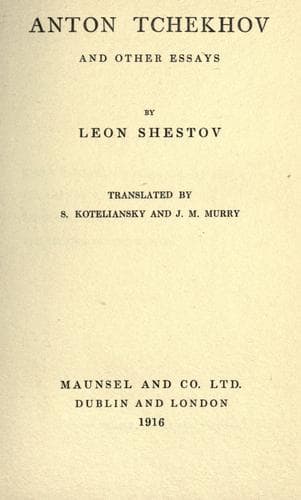
Chekhov, Anton Pavlovich, 1860-1904; Dostoyevsky, Fyodor, 1821-1881; Philosophy; Russian literature -- History and criticism
Here is the essence of the words
quoted from Tchekhov. He confesses with horror the presence within him
of that 'new' idea. It seems to him that he alone of all men is so weak
and insignificant, that the others ... well, they need only ideals
and conceptions. And so it is, surely, if we may believe what people
write in books. Tchekhov plagues, tortures and worries himself in every
possible way, but he can alter nothing; nay worse, conceptions and
ideas, towards which a great many people behave quite carelessly--after
all, these innocent things do not merit any other attitude--in Tchekhov
become the objects of bitter, inexorable, and merciless hatred. He
cannot free himself at one single stroke from the power of ideas:
therefore he begins a long, slow and stubborn war, I would call it
a guerilla war, against the tyrant who had enslaved him. The whole
history and the separate episodes of his struggle are of absorbing
interest, because the most conspicuous representatives of literature
have hitherto been convinced that ideas have a magical power. What
are the majority of writers doing but constructing conceptions of the
world--and believing that they are engaged in a work of extraordinary
importance and sanctity? Tchekhov offended very many literary men. If
his punishment was comparatively slight, that was because he was very
cautious, and waged war with the air of bringing tribute to the enemy,
and secondly, because to talent much is forgiven.
IV
The content of _The Tedious Story_ thus reduces to the fact that the
professor, expressing his 'new' thoughts, in essence declares that
he finds it impossible to acknowledge the power of the 'idea' over
himself, or conscientiously to fulfil that which men consider the
supreme purpose, and in the service whereof they see the mission, the
sacred mission of man. 'God be my judge, I haven't courage enough
to act according to my conscience,' such is the only answer which
Tchekhov finds in his soul to all demands for a 'conception.' This
attitude towards 'conceptions' becomes second nature with Tchekhov.
A conception makes demands; a man acknowledges the justice of these
demands and methodically satisfies none of them. Moreover, the justice
of the demands meets with less and less acknowledgment from him. In
_The Tedious Story_ the idea still judges the man and tortures him
with the mercilessness peculiar to all things inanimate. Exactly like
a splinter stuck into a living body, the idea, alien and hostile,
mercilessly performs its high mission, until at length the man firmly
resolves to draw the splinter out of his flesh, however painful that
difficult operation may be. In _Ivanov_ the rôle of the idea is
already changed. There not the idea persecutes Tchekhov, but Tchekhov
the idea, and with the subtlest division and contempt. The voice of
the living nature rises above the artificial habits of civilisation.
True, the struggle still continues, if you will, with alternating
fortunes.
Public-domain text, read in full here on John Shaqi.
Reviews
Reviews
No reviews yet
Be the first to share your thoughts on this work.
Join the Discussion
Join the discussion
Sign in to leave a comment or review.
Sign InorCreate an account