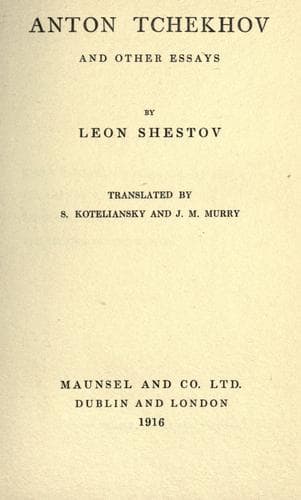
Chekhov, Anton Pavlovich, 1860-1904; Dostoyevsky, Fyodor, 1821-1881; Philosophy; Russian literature -- History and criticism
But the old humility is no more. More and more Tchekhov
emancipates himself from old prejudices and goes--he himself could
hardly say whither, were he asked. But he prefers to remain without
an answer, rather than to accept any of the traditional answers. 'I
know quite well I have no more than six months to live; and it would
seem that now I ought to be mainly occupied with questions of the
darkness beyond the grave, and the visions which will visit my sleep
in the earth. But somehow my soul is not curious of these questions,
though my mind grants every atom of their importance.' In contrast to
the habits of the past, reason is once more pushed out of the door
with all due respect, while its rights are handed over to the 'soul,'
to the dark, vague aspiration which Tchekhov by instinct trusts more
than the bright, clear consciousness which beforehand determines the
beyond, now that he stands before the fatal pale which divides man from
the eternal mystery. Is scientific philosophy indignant? Is Tchekhov
undermining its surest foundations? But he is an overstrained, abnormal
man. Certainly you are not bound to listen to him; but once you have
decided to do so then you must be prepared for anything. A normal
person, even though he be a metaphysician of the extremest ethereal
brand, always adjusts his theories to the requirements of the moment;
he destroys only to build up from the old material once more. This is
the reason why material never fails him. Obedient to the fundamental
law of human nature, long since noted and formulated by the wise, he
is content to confine himself to the modest part of a seeker after
forms. Out of iron, which he finds in nature ready to his hand, he
forges a sword or a plough, a lance or a sickle. The idea of creating
out of a void hardly even enters his mind. But Tchekhov's heroes,
persons abnormal _par excellence,_ are faced with this abnormal and
dreadful necessity. Before them always lies hopelessness, helplessness,
the utter impossibility of any action whatsoever. And yet they live
on, they do not die. A strange question, and one of extraordinary
moment, here suggests itself. I said that it was foreign to human
nature to create out of a void. Yet nature often deprives man of
ready material, while at the same time she demands imperatively that
he should create. Does this mean that nature contradicts herself,
or that she perverts her creatures? Is it not more correct to admit
that the conception of perversion is of purely human origin. Perhaps
nature is much more economical and wise than our wisdom, and maybe we
should discover much more if instead of dividing people into necessary
and superfluous, useful and noxious, good and bad, we suppressed
the tendency to subjective valuation in ourselves and endeavoured
with greater confidence to accept her creations? Otherwise you come
immediately--to 'the evil gleam,' 'treasure-digging,' sorcery and
black magic--and a wall is raised between men which neither logical
Public-domain text, read in full here on John Shaqi.
Reviews
Reviews
No reviews yet
Be the first to share your thoughts on this work.
Join the Discussion
Join the discussion
Sign in to leave a comment or review.
Sign InorCreate an account