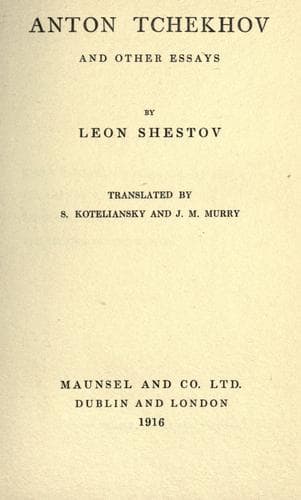
Chekhov, Anton Pavlovich, 1860-1904; Dostoyevsky, Fyodor, 1821-1881; Philosophy; Russian literature -- History and criticism
argument nor even a battery of artillery can break down. I hardly dare
hope that this consideration will appear convincing to those who are
used to maintaining the norm; and it is probably unnecessary that the
notion of the great opposition of good and bad which is alive among
men should die away, just as it is unnecessary that children should
be born with the experience of men, or that red cheeks and curly hair
should vanish from the earth. At any rate it is impossible. The world
has many centuries to its reckoning, many nations have lived and died
upon the earth, yet as far as we know from the books and traditions
that have survived to us, the dispute between good and evil was never
hushed. And it always so happened that good was not afraid of the light
of day, and good men lived a united, social life; while evil hid itself
in darkness, and the wicked always stood alone. Nor could it have been
otherwise.
All Tchekhov's heroes fear the light. They are lonely. They are ashamed
of their hopelessness, and they know that men cannot help them.
They go somewhere, perhaps even forward, but they call to no one to
follow. All things are taken from them: they must create everything
anew. Thence most probably is derived the unconcealed contempt with
which they behave to the most precious products of common human
creativeness. On whatever subject you begin to talk with a Tchekhov
hero he has one reply to everything: _Nobody can teach me anything._
You offer him a new conception of the world: already in your very
first words he feels that they all reduce to an attempt to lay the old
bricks and stones over again, and he turns from you with impatience,
and often with rudeness. Tchekhov is an extremely cautious writer.
He fears and takes into account public opinion. Yet how unconcealed
is the aversion he displays to accepted ideas and conceptions of the
world. In _The Tedious Story,_ he at any rate preserves the tone and
attitude of outward obedience. Later he throws aside all precautions,
and instead of reproaching himself for his inability to submit to the
general idea, openly rebels against it and jeers at it. In _Ivanov_ it
already is sufficiently expressed; there was reason for the outburst
of indignation which this play provoked in its day. Ivanov, I have
already said, is a dead man. The only thing the artist can do with
him is to bury him decently, that is, to praise his past, pity his
present, and then, in order to mitigate the cheerless impression
produced by death, to invite the general idea to the funeral. He might
recall the universal problems of humanity in any one of the many
stereotyped forms, and thus the difficult case which seemed insoluble
would be removed. Together with Ivanov's death he should portray a
bright young life, full of promise, and the impression of death and
destruction would lose all its sting and bitterness. Tchekhov does just
the opposite. Instead of endowing youth and ideals with power over
Public-domain text, read in full here on John Shaqi.
Reviews
Reviews
No reviews yet
Be the first to share your thoughts on this work.
Join the Discussion
Join the discussion
Sign in to leave a comment or review.
Sign InorCreate an account