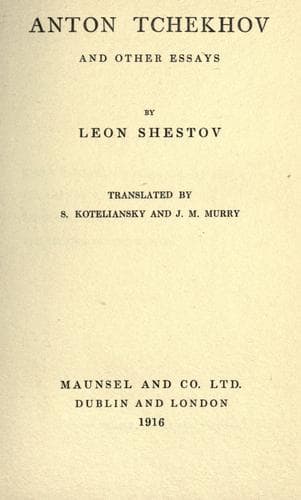
Chekhov, Anton Pavlovich, 1860-1904; Dostoyevsky, Fyodor, 1821-1881; Philosophy; Russian literature -- History and criticism
It would show small understanding of Tchekhov to take it into one's
head to interpret Ivanov's words to Lvov as meaning that Tchekhov,
like the Tolstoi of the _War and Peace_ period, saw his ideal in the
everyday arrangement of life. Tchekhov was only fighting against
the idea, and he said to it the most abusive thing that entered his
head. For what can be more insulting to the idea than to be forced
to listen to the praise of everyday life? But when the opportunity
came his way, Tchekhov could describe everyday life with equal venom.
The story, _The Teacher of Literature,_ may serve as an example. The
teacher lives entirely by Ivanov's prescription. He has his job, and
his wife--neither Jewess nor abnormal, nor blue-stocking--and a home
that fits like a shell...; but all this does not prevent Tchekhov
from driving the poor teacher by slow degrees into the usual trap, and
bringing him to a condition wherein it is left to him only 'to fall
down and weep, and beat his head against the floor.' Tchekhov had no
'ideal,' not even the ideal of 'everyday life' which Tolstoi glorified
with such inimitable and incomparable mastery in his early works. An
ideal presupposes submission, the voluntary denial of one's own right
to independence, freedom and power; and demands of this kind, even a
hint of such demands, roused in Tchekhov all that force of disgust and
repulsion of which he alone was capable.
[Footnote 1: A hero from Fon-Vizin's play _The Minor._ Starodoum is a
_raisonneur,_ a 'positive' type, always uttering truisms.]
V
Thus the real, the only hero of Tchekhov, is the hopeless man. He
has absolutely no _action_ left for him in life, save to beat his
head against the stones. It is not surprising that such a man should
be intolerable to his neighbours. Everywhere he brings death and
destruction with him. He himself is aware of it, but he has not the
power to go apart from men. With all his soul he endeavours to tear
himself out of his horrible condition. Above all he is attracted to
fresh, young, untouched beings; with their help he hopes to recover his
right to life which he has lost. The hope is vain. The beginning of
decay always appears, all-conquering, and at the end Tchekhov's hero
is left to himself alone. He has nothing, he must create everything
for himself. And this 'creation out of the void,' or more truly the
possibility of this creation, is the only problem which can occupy and
inspire Tchekhov. When he has stripped his hero of the last shred, when
nothing is left for him but to beat his head against the wall, Tchekhov
begins to feel something like satisfaction, a strange fire lights in
his burnt-out eyes, a fire which Mihailovsky did not call 'evil' in
vain.
Public-domain text, read in full here on John Shaqi.
Reviews
Reviews
No reviews yet
Be the first to share your thoughts on this work.
Join the Discussion
Join the discussion
Sign in to leave a comment or review.
Sign InorCreate an account