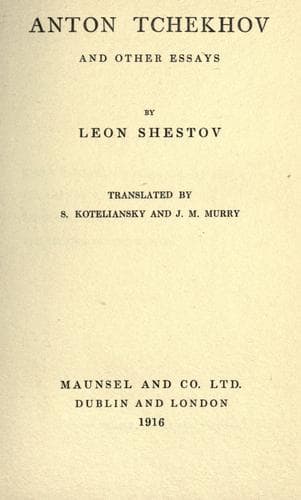
Chekhov, Anton Pavlovich, 1860-1904; Dostoyevsky, Fyodor, 1821-1881; Philosophy; Russian literature -- History and criticism
For contrast's sake Tchekhov brings Layevsky into collision with the
zoologist, Von Koren, who has come to the seaside town on important
business--every one recognises its importance--to study the embryology
of the medusa. Von Koren, as one may see from his name, is of German
origin, and therefore deliberately represented as a healthy, normal,
clean man, the grandchild of Goncharov's Stolz, the direct opposite
of Layevsky, who on his side is nearly related to our old friend
Oblomov. But in Goncharov the contrast between Stolz and Oblomov is
quite different in nature and meaning to the contrast in Tchekhov. The
novelist of the 'forties hoped that a _rapprochement_ with Western
culture would renew and resuscitate Russia. And Oblomov himself is not
represented as an utterly hopeless person. He is only lazy, inactive,
unenterprising. You have the feeling that were he to awaken he would
be a match for a dozen Stolzs. Layevsky is a different affair. He is
awake already, he was awakened years ago, but his awakening did him no
good.... 'He does not love nature; he has no God; he or his companions
had ruined every trustful girl he had known; all his life long he
had not planted one single little tree, nor grown one blade of grass
in his own garden, nor while he lived among the living, had he saved
the life of one single fly; but only ruined and destroyed, and lied,
and lied....' The good-natured sluggard Oblomov degenerated into a
disgusting, terrible animal, while the clean Stolz lived and remained
clean in his posterity! But to the new Oblomov he speaks differently.
Von Koren calls Layevsky a scoundrel and a rogue, and demands that
he should be punished with the utmost severity. To reconcile them is
impossible. The more they meet, the deeper, the more merciless, the
more implacable is their hatred for each other. It is impossible that
they should live together on the earth. It must be one or the other:
either the normal Von Koren, or the degenerate decadent Layevsky.
Of course, all the external, material force is on Von Koren's side
in the struggle. He is always in the right, always victorious,
always triumphant--in act no less than in theory. It is curious that
Tchekhov, the irreconcilable enemy of all kinds of philosophy--not
one of his heroes philosophises, or if he does, his philosophising is
unsuccessful, ridiculous, weak and unconvincing--makes an exception
for Von Koren, a typical representative of the positive, materialistic
school. His words breathe vigour and conviction. They have in them even
pathos and a maximum of logical sequence. There are many materialist
heroes in Tchekhov's stories, but in their materialism there is a
tinge of veiled idealism, according to the stereotyped prescription of
the 'sixties. Such heroes Tchekhov ridicules and derides. Idealism of
every kind, whether open or concealed, roused feelings of intolerable
bitterness in Tchekhov. He found it more pleasant to listen to the
Public-domain text, read in full here on John Shaqi.
Reviews
Reviews
No reviews yet
Be the first to share your thoughts on this work.
Join the Discussion
Join the discussion
Sign in to leave a comment or review.
Sign InorCreate an account