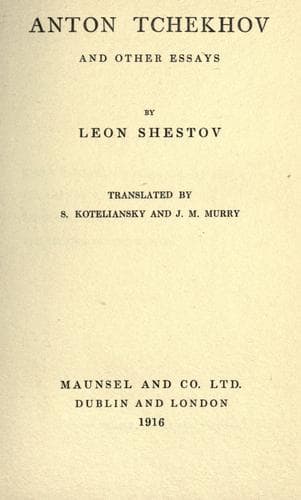
Chekhov, Anton Pavlovich, 1860-1904; Dostoyevsky, Fyodor, 1821-1881; Philosophy; Russian literature -- History and criticism
merciless menaces of a downright materialist than to accept the
dry-as-dust consolations of humanising idealism. An invincible power
is in the world, crushing and crippling man--this is clear and even
palpable. The least indiscretion, and the mightiest and the most
insignificant alike fall victims to it. One can only deceive oneself
about it so long as one knows of it only by hearsay. But the man who
had once been in the iron claws of necessity loses for ever his taste
for idealistic self-delusion. No more does he diminish the enemy's
power, he will rather exaggerate it. And the pure logical materialism
which Von Koren professes gives the most complete expression of our
dependence upon the elemental powers of nature. Von Koren's speech
has the stroke of a hammer, and each blow strikes not Layevsky but
Tchekhov himself on his wounds. He gives more and more strength to
Von Koren's arm, he puts himself in the way of his blows. For what
reason? Decide as you may. Perhaps Tchekhov cherished a secret hope
that self-inflicted torment might be the one road to a new life? He
has not told us so. Perhaps he did not know the reason himself, and
perhaps he was afraid to offend the positive idealism which held such
undisputed sway over contemporary literature. As yet he dared not
lift up his voice against the public opinion of Europe--for we do not
ourselves invent our philosophical conceptions; they drift down on the
wind from Europe! And, to avoid quarrelling with people, he devised
a commonplace, happy ending for his terrible story. At the end of
the story Layevsky 'reforms': he marries his mistress; gives up his
dissolute life; and begins to devote himself to transcribing documents,
in order to pay his debts. Normal people can be perfectly satisfied,
since normal people read only the last lines of the fable,--the moral;
and the moral of _The Duel_ is most wholesome: Layevsky reforms and
begins transcribing documents. Of course it may seem that such an
ending is more like a gibe at morality; but normal people are not too
penetrating psychologists. They are scared of double meanings and, with
the 'sincerity' peculiar to themselves, they take every word of the
writer for good coin. Good luck to them!
VII
Public-domain text, read in full here on John Shaqi.
Reviews
Reviews
No reviews yet
Be the first to share your thoughts on this work.
Join the Discussion
Join the discussion
Sign in to leave a comment or review.
Sign InorCreate an account