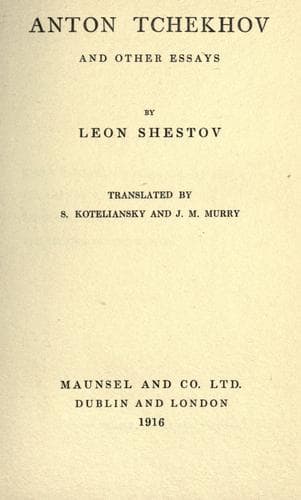
Chekhov, Anton Pavlovich, 1860-1904; Dostoyevsky, Fyodor, 1821-1881; Philosophy; Russian literature -- History and criticism
The only philosophy which Tchekhov took seriously, and therefore
seriously fought, was positivist materialism--just the positivist
materialism, the limited materialism which does not pretend to
theoretical completeness. With all his soul Tchekhov felt the awful
dependence of a living being upon the invisible but invincible and
ostentatiously soulless laws of nature. And materialism, above all
scientific materialism, which is reserved and does not hasten in
pursuit of the final word, and eschews logical completeness, wholly
reduces to the definition of the external conditions of our existence.
The experience of every day, every hour, every minute, convinces us
that lonely and weak man brought to face with the laws of nature,
must always adapt himself and give way, give way, give way. The old
professor could not regain his youth; the overstrained Ivanov could
not recover his strength; Layevsky could not wash away the filth
with which he was covered--interminable series of implacable, purely
materialistic _non possumus,_ against which human genius can set
nothing but submission or forgetfulness. _Résigne-toi, mon cœur,
dors ton sommeil de brute--_we shall find no other words before
the pictures which are unfolded in Tchekhov's books. The submission
is but an outward show; under it lies concealed a hard, malignant
hatred of the unknown enemy. Sleep and oblivion are only seeming.
Does a man sleep, does he forget, when he calls his sleep, _sommeil
de brute_? But how can he change? The tempestuous protests with which
_The Tedious Story_ is filled, the need to pour forth the pent-up
indignation, soon begin to appear useless, and even insulting to
human dignity. Tchekhov's last rebellious work is _Uncle Vanya._ Like
the old professor and like Ivanov, Uncle Vanya raises the alarm and
makes an incredible pother about his ruined life. He, too, in a voice
not his own, fills the stage with his cries: 'Life is over, life
is over,'--as though indeed any of these about him, any one in the
whole world, could be responsible for his misfortune. But wailing and
lamentation is not sufficient for him. He covers his own mother with
insults. Aimlessly, like a lunatic, without need or purpose, he begins
shooting at his imaginary enemy, Sonya's pitiable and unhappy father.
His voice is not enough, he turns to the revolver. He is ready to fire
all the cannon on earth, to beat every drum, to ring every bell. To
him it seems that the whole of mankind, the whole of the universe, is
sleeping, that the neighbours must be awakened. He is prepared for
any extravagance, having no rational way of escape; for to confess at
once that there is no escape is beyond the capacity of any man. Then
begins a Tchekhov history: 'He cannot reconcile himself, neither can
he refuse so to reconcile himself. He can only weep and beat his head
against the wall.' Uncle Vanya does it openly, before men's eyes; but
how painful to him is the memory of this frank unreserve! When every
Public-domain text, read in full here on John Shaqi.
Reviews
Reviews
No reviews yet
Be the first to share your thoughts on this work.
Join the Discussion
Join the discussion
Sign in to leave a comment or review.
Sign InorCreate an account