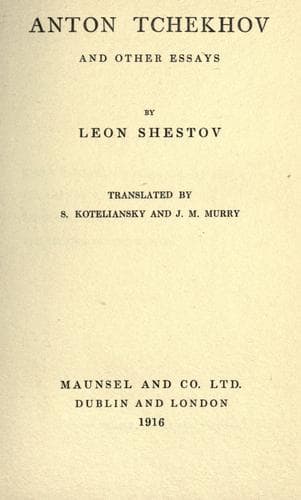
Chekhov, Anton Pavlovich, 1860-1904; Dostoyevsky, Fyodor, 1821-1881; Philosophy; Russian literature -- History and criticism
death? Again we must answer: 'I do not know,'--those words which
arouse the greatest aversion in positive thinkers, but appear in some
mysterious way to be the permanent elements in the ideas of Tchekhov's
people. This is the reason why the philosophy of materialism, though
so hostile, is yet so near to them. It contains no answer which can
compel man to cheerful submission. It bruises and destroys him, but
it does not call itself rational; it does not demand gratitude; it
does not demand anything, since it has neither soul nor speech. A
man may acknowledge it and hate it. If he manages to get square with
it--he is right; if he fails--_vae victis._ How comfortably sounds
the voice of the unconcealed ruthlessness of inanimate, impersonal,
indifferent nature, compared with the hypocritical and cloying melodies
of idealistic, humanistic conceptions of the world! Then again--and
this is the chiefest thing of all--men can struggle with nature still!
And in the struggle with nature every weapon is lawful. In the struggle
with nature man always remains man, and, therefore, right, whatever
means he tries for his salvation, even if he were to refuse to accept
the fundamental principle of the world's being--the indestructibility
of matter and energy, the law of inertia and the rest--since who will
dispute that the most colossal dead force must be subservient to
man? But a conception of the world is an utterly different affair!
Before uttering a word it puts forward an irreducible demand: man must
serve the idea. And this demand is considered not merely as something
understood, but as of extraordinary sublimity. Is it strange then
that in the choice between idealism and materialism Tchekhov inclined
to the latter--the strong but honest adversary? With idealism a man
can struggle only by contempt, and Tchekhov's works leave nothing
to be desired in this respect.... But how shall a man struggle with
materialism? And can it be overcome? Perhaps Tchekhov's method may
seem strange to my reader, nevertheless it is clear that he came to
the conclusion that there was only one way to struggle, to which the
prophets of old turned themselves: to beat one's head against the wall.
Without thunder or cannon or alarm, in loneliness and silence, remote
from their fellows and their fellows' fellows, to gather all the forces
of despair for an absurd attempt long since condemned by science.
Have you any right to expect from Tchekhov an approval of scientific
methods? Science has robbed him of everything: he is condemned to
create from the void, to an activity of which a normal man, using
normal means, is utterly incapable. To achieve the impossible one must
first leave the road of routine. However obstinately we may pursue
our scientific quests, they will not lead us to the elixir of life.
Science began with casting away the longing for human omnipotence as in
principle unattainable: her methods are such that success along certain
Public-domain text, read in full here on John Shaqi.
Reviews
Reviews
No reviews yet
Be the first to share your thoughts on this work.
Join the Discussion
Join the discussion
Sign in to leave a comment or review.
Sign InorCreate an account