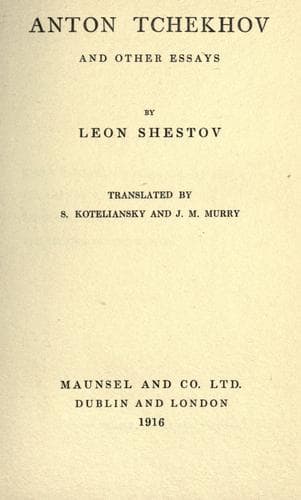
Chekhov, Anton Pavlovich, 1860-1904; Dostoyevsky, Fyodor, 1821-1881; Philosophy; Russian literature -- History and criticism
of her paths preclude even seeking along others. In other words,
scientific method is defined by the character of the problems which
she puts to herself. Indeed, not one of her problems can be solved by
beating one's head against the wall. But this method, old-fashioned
though it is--I repeat, it was known to the prophets and used by
them--promised more to Tchekhov and his nerves than all inductions and
deductions (which were not invented by science, but have existed since
the beginning of the world). This prompts a man with some mysterious
instinct, and appears upon the scene whenever the need of it arises.
Science condemns it. But that is nothing strange: it condemns science.
VIII
Now perhaps the further development and direction of Tchekhov's
creation will be intelligible, and that peculiar and unique blend
in him of sober materialism and fanatical stubbornness in seeking
new paths, always round about and hazardous. Like Hamlet, he would
dig beneath his opponent a mine one yard deeper, so that he may
at one moment blow engineer and engine into the air. His patience
and fortitude in this hard, underground toil are amazing and to
many intolerable. Everywhere is darkness, not a ray, not a spark,
but Tchekhov goes forward, slowly, hardly, hardly moving.... An
inexperienced or impatient eye will perhaps observe no movement at all.
It may be Tchekhov himself does not know for certain whether he is
moving forward or marking time. To calculate beforehand is impossible.
Impossible even to hope. Man has entered that stage of his existence
wherein the cheerful and foreseeing mind refuses its service. It is
impossible for him to present to himself a clear and distinct notion of
what is going on. Everything takes on a tinge of fantastical absurdity.
One believes and disbelieves--everything. In _The Black Monk_ Tchekhov
tells of a new reality, and in a tone which suggests that he is himself
at a loss to say where the reality ends and the phantasmagoria begins.
The black monk leads the young scholar into some mysterious remoteness,
where the best dreams of mankind shall be realised. The people about
call the monk a hallucination and fight him with medicines--drugs,
better foods and milk. Kovrin himself does not know who is right. When
he is speaking to the monk, it seems to him that the monk is right;
when he sees before him his weeping wife and the serious, anxious
faces of the doctors, he confesses that he is under the influence of
fixed ideas, which lead him straight to lunacy. Finally the black
monk is victorious. Kovrin has not the power to support the banality
which surrounds him; he breaks with his wife and her relations, who
appear like inquisitors in his eyes, and goes away somewhere--but in
our sight he arrives nowhere. At the end of the story he dies in order
to give the author the right to make an end. This is always the case:
when the author does not know what to do with his hero he kills him.
Public-domain text, read in full here on John Shaqi.
Reviews
Reviews
No reviews yet
Be the first to share your thoughts on this work.
Join the Discussion
Join the discussion
Sign in to leave a comment or review.
Sign InorCreate an account