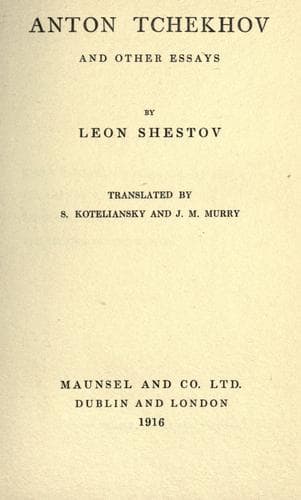
Chekhov, Anton Pavlovich, 1860-1904; Dostoyevsky, Fyodor, 1821-1881; Philosophy; Russian literature -- History and criticism
Sooner or later in all probability this habit will be abandoned. In
the future, probably, writers will convince themselves and the public
that any kind of artificial completion is absolutely superfluous.
The matter is exhausted--stop the tale short, even though it be on
a half-word. Tchekhov did so sometimes, but only sometimes. In most
cases he preferred to satisfy the traditional demands and to supply his
readers with an end. This habit is not so unimportant as at first sight
it may seem. Consider even _The Black Monk._ The death of the hero is
as it were an indication that abnormality must, in Tchekhov's opinion,
necessarily lead through an absurd life to an absurd death: but this
was hardly Tchekhov's firm conviction. It is clear that he expected
something from abnormality, and therefore gave no deep attention to
men who had left the common track. True, he came to no firm or definite
conclusions, for all the tense effort of his creation. He became so
firmly convinced that there was no issue from the entangled labyrinth,
that the labyrinth with its infinite wanderings, its perpetual
hesitations and strayings, its uncaused griefs and joys uncaused--in
brief, all things which normal men so fear and shun--became the very
essence of his life. Of this and this alone must a man tell. Not of our
invention is normal life, nor abnormal. Why then should the first alone
be considered as the real reality?
_The Sea-Gull_ must be considered one of the most characteristic, and
therefore one of the most remarkable of Tchekhov's works. Therein the
artist's true attitude to life received its most complete expression.
Here all the characters are either blind, and afraid to move from
their seats in case they lose the way home, or half-mad, struggling
and tossing about to no end nor purpose. Arkadzina the famous actress
clings with her teeth to her seventy thousand roubles, her fame, and
her last lover. Tregovin the famous writer writes day in, day out;
he writes and writes, knowing neither end nor aim. People read his
works and praise them, but he is not his own master; like Marko, the
ferryman in the tale, he labours on without taking his hand from the
oar, carrying passengers from one bank to the other. The boat, the
passengers, and the river too, bore him to death. But how can he get
rid of them? He might give the oars over to the first-comer: the
solution is simple, but after it, as in the tale, he must go to heaven.
Not Tregovin alone, but all the people in Tchekhov's books who are
no longer young remind one of Marko the ferryman. It is plain that
they dislike their work, but, exactly as though they were hypnotised,
they cannot break away from the influence of the alien power. The
monotonous, even dismal, rhythm of life has lulled their consciousness
and will to sleep. Everywhere Tchekhov underlines this strange and
mysterious trait of human life. His people always speak, always think,
always do one and the same thing. One builds houses according to a plan
Public-domain text, read in full here on John Shaqi.
Reviews
Reviews
No reviews yet
Be the first to share your thoughts on this work.
Join the Discussion
Join the discussion
Sign in to leave a comment or review.
Sign InorCreate an account