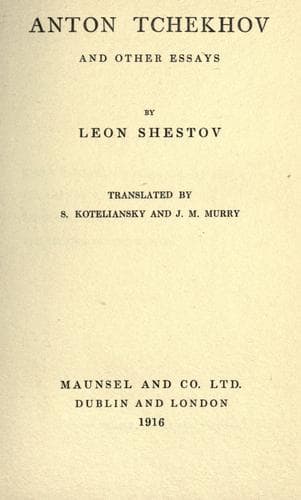
Chekhov, Anton Pavlovich, 1860-1904; Dostoyevsky, Fyodor, 1821-1881; Philosophy; Russian literature -- History and criticism
I hope the clarity of the foregoing exposition will
to some extent atone for it.
II
_Self-renunciation and Megalomania_
We are obliged to think that nothing certain can be said either of
self-renunciation or of megalomania, though each one of us in his own
experience knows something of the former as well as of the latter. But
it is well known that the impossibility of solving a question never yet
kept people from reflecting. On the contrary: to us the most alluring
questions are those to which there is no actual, no universally valid,
answer. I hope that sooner or later, philosophy will be thus defined,
in contrast to science:--philosophy is the teaching of truths which
are binding on none. Thereby the accusation so often made against
philosophy will be removed, that philosophy properly consists of a
series of mutually exclusive opinions. This is true, but she must be
praised for it, not blamed: there is nothing bad in it, but good, a
very great deal of good. On the other hand, it is bad, extremely bad,
that science should consist of truths universally binding. For every
obligation is a constraint. Temporarily, one can submit to a restraint,
put on a corset, fetters; one can agree to anything temporarily. Rut
who will voluntarily admit the mastery over himself of an eternal law?
Even from the quiet and clear Spinoza I sometimes hear a deep sigh, and
I think that he is longing for freedom--he who wasted all his life,
all his genius in the glorification of necessity.... With such an
introduction one may say what he pleases.
It seems to me that self-renunciation and megalomania, however little
they resemble one another apparently, may be observed successively,
even simultaneously, in one and the same person. The ascetic, who
has denied life and humbles himself before everybody, and the madman
(like Nietzsche or Dostoevsky), who affirms that he is the light, the
salt of the earth, the first in the whole world or even in the whole
universe--both reach their madness--I hope there is no necessity to
demonstrate that self-renunciation as well as megalomania is a kind of
madness--under conditions for the most part identical. The world does
not satisfy the man and he begins to seek for a better. All serious
seeking brings a man to lonely paths, and lonely paths, it is well
known, end in a great wall which sets a fatal bound to man's curiosity.
Then arises the question, how shall a man pass beyond the wall, by
overcoming either the law of impenetrability or the equally invincible
law of gravity, in other words, how shall a man become infinitely small
or infinitely great? The first way is that of self-renunciation: I want
nothing, I myself am nothing, I am infinitely small, and therefore I
can pass through the infinitely small pores of the wall.
Public-domain text, read in full here on John Shaqi.
Reviews
Reviews
No reviews yet
Be the first to share your thoughts on this work.
Join the Discussion
Join the discussion
Sign in to leave a comment or review.
Sign InorCreate an account