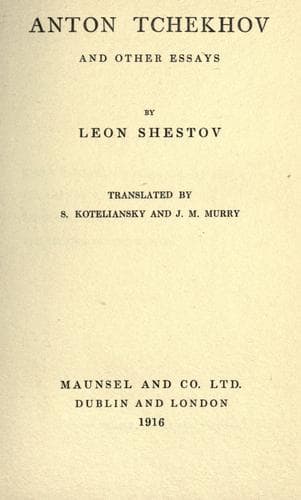
Chekhov, Anton Pavlovich, 1860-1904; Dostoyevsky, Fyodor, 1821-1881; Philosophy; Russian literature -- History and criticism
The other way is megalomania. I am infinitely strong, infinitely
great, I can do all things, I can shatter the wall, I can step over
it, though it be higher than all the mountains of the earth and though
it has hitherto dismayed the strongest and the bravest. This is
probably the origin of the two most mysterious and mighty spiritual
transformations. There is no single religion upon which are not more or
less clearly impressed the traces of these methods of man's struggle
with the poverty of his powers. In ascetic religions the tendency to
self-renunciation predominates: Buddhism glorifies the suppression
of the individual and has for its ideal Nirvana. The Greeks dreamed
of Titans and heroes. The Jews consider themselves the chosen people
and await the Messiah. As for the Gospel, it is hard to say to which
method of struggle it gives the preference. On the one hand are the
great miracles, the raising from the dead, the healing of the sick, the
power over the winds and the sea; on the other: 'Blessed are the poor
in spirit.' The Son of God who will sit on the right hand of power now
lives in the company of publicans, beggars, and harlots, and serves
them. 'Who is not for us, is against us'; the promise to thrust down
his enemies into the fiery hell; eternal torment for blasphemy against
the Holy Spirit, and equal with these the exhortation to the extreme
of humility and love to the enemy: 'Turn to him the other cheek also.'
Throughout, the Gospel is permeated with contradictions, which are
not extraneous and historical, concerned with facts, but intrinsic,
contradictions of mood, of 'ideals,' as the modern man would say.
What is in one chapter praised as the noblest task is in the next
degraded to an unworthy labour. It is in no way strange that the most
opposite teachings should find justification in this little book,
which is half composed of repetitions. The Inquisitors, the Jesuits,
and the old ascetics called themselves. Christians; so do the modern
Protestants and our Russian sectaries. To a greater or less degree
they all are right, even the Protestants. Such contradictory elements
are intertwined in the Gospel, that men, above all those who travel
the high road, who can move in one direction only, and under one
conspicuous flag, who have become accustomed to believe in the unity
of reason and the infallibility of logical laws, could never fully
grasp the teaching of the Gospel, and always aspired to give to the
words and deeds of Christ a uniform explanation which should exclude
contradictions, and more or less correspond to the common conceptions
of the work and problems of life. They read in the mysterious book,
'Have faith and thou shalt say to this mountain: be thou removed,' and
understood it to mean that always, every hour and every minute, one
must think and desire the self-same thing, prescribed beforehand and
fully denned; whereas in these words the Gospel allows and commends the
maddest and most perilous experiments.
Public-domain text, read in full here on John Shaqi.
Reviews
Reviews
No reviews yet
Be the first to share your thoughts on this work.
Join the Discussion
Join the discussion
Sign in to leave a comment or review.
Sign InorCreate an account