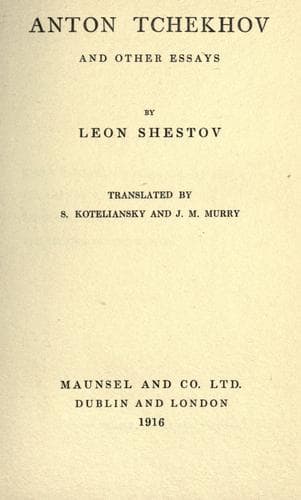
Chekhov, Anton Pavlovich, 1860-1904; Dostoyevsky, Fyodor, 1821-1881; Philosophy; Russian literature -- History and criticism
Socrates lived seventy years. He was once a youth, once a man, once
a greybeard. But what if he had lived a hundred and forty years,
experienced once again all the three seasons of life, and had again met
Hippias? Or, better still, if the soul, as Socrates taught, is immortal
and Socrates now lives somewhere in the moon or Sirius, or in any other
place predestined for immortal souls, does he really go on plaguing his
companions with discourses on justice, carpenters, and smiths? And does
he still emerge victorious as of old from the dispute with Hippias and
other persons who dare to affirm that everything (human convictions
included) may be, and ought to be, subject to the laws of time, and
that mankind not only loses nothing, but gains much by such subjection?
IV
_Earth and Heaven_
The word justice is on all men's lips. But do men indeed so highly
prize justice as one would think, who believed all that has been
said and is still being said concerning it? More than this, is it so
highly appreciated by its sworn advocates and panegyrists--poets,
philosophers, moralists, theologians--even by the best of them, the
most sincere and gifted? I doubt it, I doubt it deeply. Glance at the
works of any wise man, whether of the modern or the ancient world.
Justice, if we understand it as the equality of all living men before
the laws of creation--and how else can we understand it?--never
occupied any one's attention. Plato never once asked Destiny why she
created Thersites contemptible and Patroclus noble. Plato argues that
men should be just, but never once dares to arraign the gods for their
injustice. If we listen to his discourses, a suspicion will steal into
our souls that justice is a virtue for mortals, while the immortals
have virtues of their own which have nothing in common with justice.
And here is the last trial of earthly virtue. We do not know whether
the human soul is mortal or immortal. Some, we know, believe in
immortality, others laugh at the belief. If it were proved that they
were both in the wrong, and that men's destinies after death are as
unequal as they are in life: the successful, the chosen take up their
abode in heaven, the others remain to rot in the grave and perish with
their mortal clay. (It is true that such an admission is made by our
Russian prophet, the priest of love and justice, Dostoevsky, in his
_Legend of the Grand Inquisitor._) Now, if it should turn out that
Dostoevsky is really immortal, while his innumerable disciples and
admirers, the huge mass of grey humanity which is spoken of in _The
Grand Inquisitor,_ end their lives in death as they began them with
birth, would Dostoevsky himself (whom I have named deliberately as
the most passionate defender of the ideal of justice, though there
have been yet more fervent and passionate and remarkable defenders of
justice on earth whom I ought perhaps to name, were it not that I would
avoid speaking lightly of sacred things--let him who finds Dostoevsky
Public-domain text, read in full here on John Shaqi.
Reviews
Reviews
No reviews yet
Be the first to share your thoughts on this work.
Join the Discussion
Join the discussion
Sign in to leave a comment or review.
Sign InorCreate an account