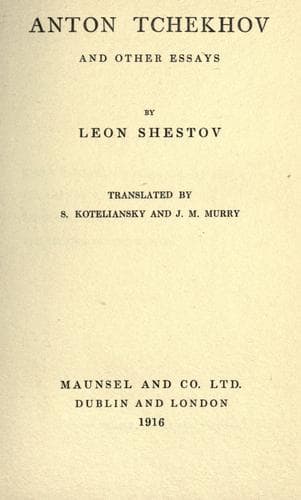
Chekhov, Anton Pavlovich, 1860-1904; Dostoyevsky, Fyodor, 1821-1881; Philosophy; Russian literature -- History and criticism
That which is, did not exist for
Christ; and only that existed, which is not.
The old Roman, Pilate, who was apparently an educated man, clever and
not bad at heart, though weak in character, could neither understand
nor elucidate the cause of the strange struggle which took place
before him. With his whole heart he pitied the pale Jew before him,
who was guilty of nothing. 'What is truth?' he asked Christ. Christ
did not answer him, nor could He answer, not through ignorance, as
the heathen desired to believe, but because that question cannot be
answered in words. It would have been necessary to take Pilate's head,
and turn it towards the other side, in order that he might see what
he had never seen before. Or, still better; to have used the method
to which the hunch-backed pony turns in the fairy tale, in order to
change sleepy Ivanushka into a wizard and a beauty: first, to plunge
him into a cauldron of boiling milk, then into another of boiling
water, then a third of ice-cold water. There is every reason to suppose
that with this preliminary preparation Pilate would have begun to
act differently, and I think the hunch-backed pony would agree that
self-renunciation and megalomania would be a fair substitute for the
cauldrons of the tale.
Great privations and great illusions so change the nature of man
that things which seemed before impossible, become possible, and the
unattainable, attainable.
III
_Eternal Truths_
In the _Memorabilia_ Xenophon tells of the meeting of Socrates with
the famous sophist Hippias. When Hippias came to Socrates, the latter
as usual held forth, and as usual asked why it is that men who wish to
learn carpentry or smith's work know to whom they should apply, but if
they desire to learn virtue, cannot possibly find a teacher. Hippias,
who had heard these opinions of Socrates many times before, remarked
ironically: 'So you're still saying the same old things, that I heard
from you years ago!' Socrates understood and accepted the challenge, as
he always accepted challenges of this kind. A dispute began, by which
it was demonstrated (as usual in Plato and Xenophon) that Socrates was
a stronger dialectician than his opponent. He succeeded in showing that
his conception of justice was based on the same firm foundation as all
his other conceptions, and that convictions once formed, if they are
true, are as little liable to the action of time as noble metals to
rust.
Public-domain text, read in full here on John Shaqi.
Reviews
Reviews
No reviews yet
Be the first to share your thoughts on this work.
Join the Discussion
Join the discussion
Sign in to leave a comment or review.
Sign InorCreate an account