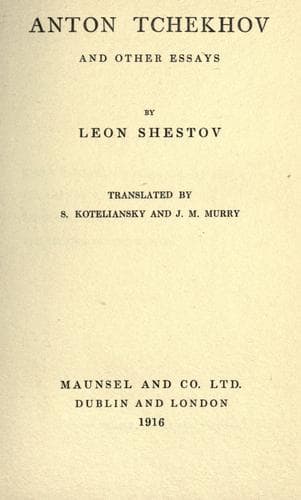
Chekhov, Anton Pavlovich, 1860-1904; Dostoyevsky, Fyodor, 1821-1881; Philosophy; Russian literature -- History and criticism
Schopenhauer answered the question of the immortality of the soul in
the negative. In his opinion, man as Thing-in-Himself is immortal, but
as phenomenon mortal. In other words, all that is individual in us
exists only in the interval between birth and death; but since each
individual according to Schopenhauer's teaching is a manifestation of
'Will' or 'Thing-in-Itself,' the unalterable and eternal principle
which is the only reality of the world, continually made object in the
manifold of phenomena, then, in so far as this principle is displayed
in man, he is eternal. This is Schopenhauer's opinion, evidently
derived as a logical conclusion from his general philosophic doctrine,
both from that relating to the Thing-in-Itself, and from that which
relates to the individual. The first part shall go unregarded: after
all, if Schopenhauer was mistaken, and the Thing-in-Itself is mortal,
we need not weep over it, nor is there any cause to rejoice over its
immortality. But here is the individual. He is deprived of his right to
immortality, and for reason is alleged an argument which is at first
sight irrefutable. Everything which has a beginning has an end also,
says Schopenhauer. The individual has a beginning, birth; therefore an
end, death, awaits him. To Schopenhauer himself the general proposition
as well as the conclusion seemed so obvious, that he did not admit
the possibility of mistake even for a moment. But this time we have
an incontestable case of a wrong conclusion from a wrong premiss.
First, why must everything which has a beginning also have an end? The
observations of experience point to such an hypothesis; but are the
observations of experience really strong enough to support general
propositions? And are we really entitled to make use of propositions
so acquired as first principles for the solution of the most important
problems of philosophy? And even if we admit that the premiss is
correct, nevertheless the conclusion at which Schopenhauer arrived is
wrongly drawn. It may indeed be that everything which has a beginning
also has an end; it may indeed be that the individual is sooner or
later doomed to perish; but why identify the moment of the soul's
destruction with the death of the body? It may be that the body will
die, but the soul which the same fate attends at some future time will
find for itself a more or less suitable integument somewhere in a
distant planet, perhaps still unknown to us, and live on, though only
for a little while and not for all eternity, as the extreme optimists
believe. How important would it be for poor humanity to retain even
such a hope: particularly seeing that we can hardly say with certainty
what it is that men desire when they speak of the immortality of the
soul. Is it that they merely desire at all costs to live eternally, or
would they be satisfied with one or two lives more, especially if the
subsequent lives should appear to be less offensively insignificant
Public-domain text, read in full here on John Shaqi.
Reviews
Reviews
No reviews yet
Be the first to share your thoughts on this work.
Join the Discussion
Join the discussion
Sign in to leave a comment or review.
Sign InorCreate an account