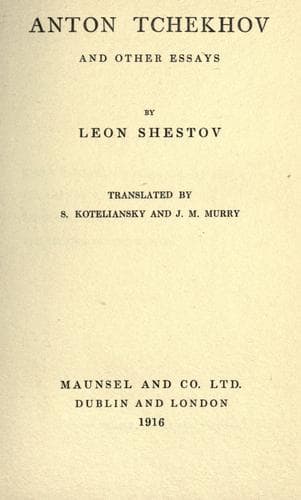
Chekhov, Anton Pavlovich, 1860-1904; Dostoyevsky, Fyodor, 1821-1881; Philosophy; Russian literature -- History and criticism
than this earthly existence, wherein even the lowest rank of nobility
is to many an unattainable ideal? It seems to me that it is not every
one who would consent to live eternally. And what if every possibility
should have been exhausted, and endless repetition should begin?
It does not of course follow from this that we have the right to
reckon upon an existence beyond the grave. The question remains open
as before, even when Schopenhauer's arguments have been refuted. But
it does follow that the best arguments on closer consideration often
appear worthless. _Quod erat demonstrandum--_ naturally pending the
discovery of arguments to refute my refutation of Schopenhauer's. I
make this reserve to deprive my critics of the pleasure and possibility
of a little wordplay.
VI
_Swan Songs_
It cannot be doubted that _When We Dead Awake_ is one of the most
autobiographical of Ibsen's plays. Nearly all his dramas reveal
striking traces of his personal experience; their most valuable
quality, even, is the possibility of following out in them the
history of the author's inward struggle. But there is a particular
significance in _When We Dead Awake,_ which comes from the fact that
it was conceived and written by the author in his old age. Those who
are interested in overhearing what is said and watching what is done
on the outskirts of life set an extraordinary value on the opportunity
of communing with very old men, with the dying, and generally with
men who are placed in exceptional conditions, above all when they are
not afraid to speak the truth, and have by past experience developed
in themselves the art and the courage--the former is as necessary as
the latter--to look straight into the eyes of reality. To such men
Ibsen seems even more interesting than Tolstoi. Tolstoi indeed has not
yet betrayed his gift; but he is primarily a moralist. Now, as in his
youth, power over men is the dearest thing of all to him, and more
fascinating than all the other blessings of the world. He still gives
orders, makes demands, and desires at all costs to be obeyed. One may,
and one ought, to consider this peculiarity of Tolstoi's nature with
attention and respect. Not Tolstoi alone, but many a regal hermit of
thought has to the end of his life demanded the unconditional surrender
of mankind. On the day of his death, an hour before end, Socrates
taught that there was only one truth and that the one which he had
discovered. Plato in his extreme old age journeyed to Syracuse to plant
the seeds of wisdom there. It is probable that such stubbornness in
great men has its explanation and its deep meaning.
Public-domain text, read in full here on John Shaqi.
Reviews
Reviews
No reviews yet
Be the first to share your thoughts on this work.
Join the Discussion
Join the discussion
Sign in to leave a comment or review.
Sign InorCreate an account