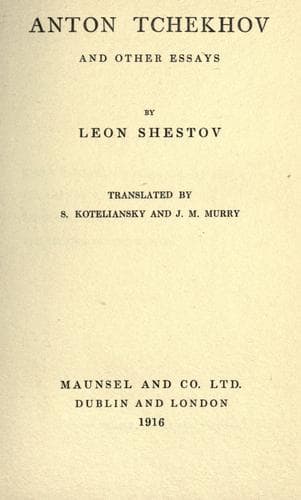
Chekhov, Anton Pavlovich, 1860-1904; Dostoyevsky, Fyodor, 1821-1881; Philosophy; Russian literature -- History and criticism
convinced, and am still certain, that dogmatists feel no shame, and
are by no means to be driven out of life; besides, I have lately come
to the conclusion that the dogmatists are perfectly justified in their
stubbornness. Belief, and the need of belief, are strong as love, as
death. In the case of every dogmatist I now consider it my sacred
duty to concede everything in advance, even to the acknowledgment
of the least, and least significant, shades of his convictions and
beliefs. There is but one limitation, one only, imperceptible and
almost invisible: the dogmatist's convictions must not be absolutely
and universally binding, that is, not binding upon the whole of
mankind without exception. The majority, the vast majority, millions,
even tens of millions of people, I will readily allow him, on the
understanding that they themselves desire it, or that he will show
himself skilful enough to entice them to his side--violence is surely
not to be admitted in matters of belief. In a word, I allow him almost
the whole of humankind, in consideration whereof he must agree that
his convictions are not intrinsically binding upon the few units or
tens that remain. I agree to an outward submission. And the dogmatist,
after such a victory--my confession is surely a complete victory for
him--must consider himself satisfied in full.
Socrates was right, Plato, Tolstoi, the prophets were right: there is
only one truth, one God; truth has the right to destroy lie, light
to destroy darkness. God, omniscient, most gracious and omnipotent,
will like Alexander of Macedon conquer nearly all the known world, and
will drive out from his possessions, amid the triumphant and delighted
shouts of his millions of loyal subjects, the devil and all those who
are disobedient to his divine word. But he will renounce his claim to
power over the souls of his few opponents, according to the agreement,
and a handful of apostates will gather together on a remote isle,
invisible to the millions, and will there continue their free, peculiar
life. And here--to return to the beginning--among these few disobedient
will be found Ibsen as he was in the last years of his life, as he is
seen in his last drama. For in _When We Dead Awake_ Ibsen approves and
glorifies that which Gogol actually did fifty years ago. He renounces
his art, and with hatred and mockery recalls to mind what was once
the business of his life. On April 15, 1866, Ibsen wrote to King Karl:
'I am not fighting for a careless existence; I am fighting for the
work of my life, in which I unflinchingly believe, and which I know
God has given me to do.' By the way, you will hardly find one of the
great workers who has not repeated this assertion of Ibsen's, whether
in the same or in another form. Evidently, without such an illusion,
temporary or permanent, one cannot compass the intense struggle and the
sacrifices which are the price of great work. Evidently, illusions of
Public-domain text, read in full here on John Shaqi.
Reviews
Reviews
No reviews yet
Be the first to share your thoughts on this work.
Join the Discussion
Join the discussion
Sign in to leave a comment or review.
Sign InorCreate an account