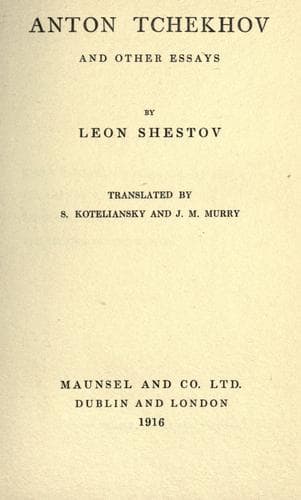
Chekhov, Anton Pavlovich, 1860-1904; Dostoyevsky, Fyodor, 1821-1881; Philosophy; Russian literature -- History and criticism
Tolstoi, and also Socrates and Plato, and the Jewish prophets, who
in this respect and in many others were very like the teachers of
wisdom, probably had to concentrate their powers wholly upon one
gigantic inward task, the condition of its successful performance
being the illusion that the whole world, the whole universe, works
in concert and unison with them. In Tolstoi's case I have elsewhere
shown that he finds himself at present on the brink of Solipsism in
his conception of the world. Tolstoi and the whole world are to him
synonymous. Without such a temporary delusion of his whole being--it
is not an intellectual delusion, of the head, for the head knows well
that the world is by itself, and Tolstoi by himself--he would have to
give up his most important work. So it is with us, who know since
Copernicus that the earth moves round the sun, that the stars are not
clear, bright, golden rings, but huge lumps of various composition,
that there is not a firm blue vault overhead. We know these things:
nevertheless we cannot and do not want to be so blind as not to take
delight in the lie of the optical illusions of the visible world. Truth
so-called has but a limited value. Nor does the sacrifice of Galileo
by any means refute my words. _E pur si muove,_ if ever he uttered the
phrase, might not have referred to the movement of the earth, though
it was spoken of the earth. Galileo did not wish to betray the work of
his life. Who will, however, stand surety to us that not only Galileo
is capable of such sacrifice, but his pupil also, even the most devoted
and courageous, who has gained the new truth not by his own struggle
but from the lips of his master. Peter in one night thrice denied
Christ. Probably we could not find a single man in all the world who
would consent to die to demonstrate and defend the idea of Galileo.
Evidently great men are very little inclined to initiate the outsider
into the secret of their great deeds. Evidently they cannot themselves
always give a clear account of the character and meaning of the tasks
which they set themselves. Socrates himself, who all his life long so
stubbornly sought clarity and invented dialectics for the purpose, and
introduced into general use definitions designed to fix the flowing
reality; Socrates, who spent thirty days without interruption in
persuading his pupils that he was dying for the sake of truth and
justice; Socrates himself, I say, perhaps, most probably even, knew as
little why he was dying as do simple people who die a natural death, or
as babes born into the world know by what beneficent or hostile power
they have been summoned from nonentity into being. Such is our life:
wise men and fools, old men and children march at random to goals which
have not yet been revealed by any books, whether worldly or spiritual,
common or sacred. It is by no means with the desire to bring dogmatism
into contempt that I recall these considerations. I have always been
Public-domain text, read in full here on John Shaqi.
Reviews
Reviews
No reviews yet
Be the first to share your thoughts on this work.
Join the Discussion
Join the discussion
Sign in to leave a comment or review.
Sign InorCreate an account