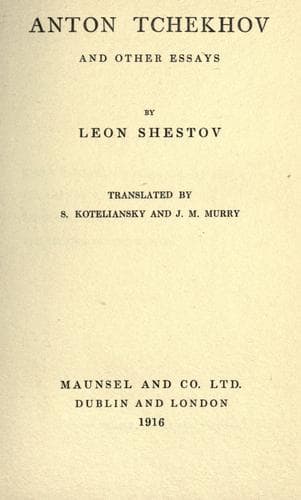
Chekhov, Anton Pavlovich, 1860-1904; Dostoyevsky, Fyodor, 1821-1881; Philosophy; Russian literature -- History and criticism
infinite--divided by two and even by the greatest possible finite
number still leaves infinity.
Now we can return to the original question, and it seems that we
can even give an answer to it--two answers even, one for the sage,
another for the profane. To the first, philosophy is art for art's
sake. Every philosopher tries to construct a harmonious and various
system, curiously and nicely fashioned, using for his material his own
intrinsic experience as well as his own personal observations of the
life beyond him, and the observations of others. A philosopher is an
artist of his kind, to whom his works are dearer than everything in
life, sometimes dearer than life itself. We very often see philosophers
sacrifice everything for the sake of their work--even truth. Not so
the profane. To them philosophy--more exactly, that which they would
call philosophy if they possessed a scientific terminology--is the last
refuge when material forces have been wasted, when there are no weapons
left to fight for their stolen rights. Then they run for help and
support to a place which they have always taken care to avoid before.
Think of Napoleon at St. Helena. He who had been collecting soldiers
and guns all his life, began to philosophise when he was bound hand and
foot. Certainly he behaved in this new sphere like a beginner, a very
inexperienced and, strange to say, a pusillanimous novice.
He who feared neither pestilence nor bullet, was afraid, we know, of
a dark room. Men used to philosophy, like Schopenhauer, walk boldly
and with confidence in a dark room, though they run away from gun
shots, and even less dangerous things. The great captain, the once
Emperor of nearly all Europe, Napoleon, philosophised on St. Helena,
and even went so far as to begin to ingratiate himself with morality,
evidently supposing that upon morality his ultimate fate depended. He
assured her that for her sake, and her sake alone, he had contrived
his murderous business--he who, all the while a crown was on his head
and a victorious army in his hands, hardly knew even of the existence
of morality. But this is so intelligible. If one were to come upon a
perfectly new and unknown world at the age of forty-five, then surely
everything would seem terrible, and one would take the incorporeal
morality for the arbiter of destiny. And one would plan to seduce
her, if possible, with sweet words and false promises, as a lady of
the world. But these were the first steps of a tyro. It was as hard
for Napoleon to master philosophy as it was for Charlemagne at the
end of his days to learn to write. But he knew why he had come to the
new place, and neither Plato nor Spinoza nor Kant could dissuade him
of this. Perhaps at the beginning, while he was as yet unused to the
darkness, he would pretend to agree with the acknowledged authorities,
thinking that here too, just as there where he lived before, exalted
personages do not tolerate opposition; perhaps he would lie to them
Public-domain text, read in full here on John Shaqi.
Reviews
Reviews
No reviews yet
Be the first to share your thoughts on this work.
Join the Discussion
Join the discussion
Sign in to leave a comment or review.
Sign InorCreate an account