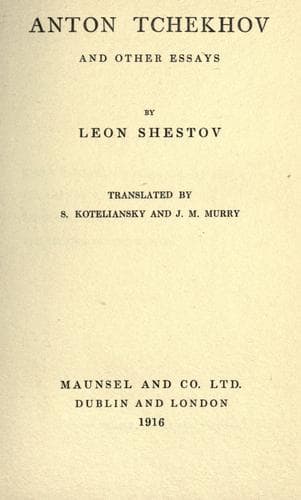
Chekhov, Anton Pavlovich, 1860-1904; Dostoyevsky, Fyodor, 1821-1881; Philosophy; Russian literature -- History and criticism
again the well-balanced German is irritated. He would prefer that no
one should ever speak of such emotions, and if they are to be spoken
of, then it must be at least in a penitent tone, with self-accusation.
But Heine's misplaced laughter is indecent and quite uselessly
disconcerting. I repeat that Heine himself was not always sure that
his 'sincerity' was lawful. While he was still a youth he told how
there suddenly ran through his soul, as through the whole earth, a
rent which split asunder the unity of his former emotions. King David
when he praised God and good did not remember his dark deeds--of
which there were not a few--or, if he did remember them, it was only
to repent. His soul was also divided, but he was able to preserve a
sequence. When he wept, he could not and did not want to rejoice;
when he repented, he was already far from sin; when he prayed, he did
not scoff; when he believed, he did not doubt. The Germans, brought
up on the great king's psalms, had come to think that these things
were impossible and ought never to be possible. They admitted the
succession of different, and even contradictory spiritual conditions,
but their simultaneous existence appeared to them unintelligible and
disgusting, in contradiction with divine commandments and the laws of
logic. It seemed to them that everything which formerly existed as
separate, had become confused, that the place of stringent harmony had
been usurped by absurdity and chaos. They thought that such a state of
things threatened innumerable miseries. They did not admit the idea
that Heine himself might not understand it; in his creation they saw
the manifestation of a false and evil will, and they invoked divine and
human judgment upon it. The Philistine irritation reached the extreme
when it became clear that Heine had not humbled himself even before the
face of death. Stricken by paralysis, he lay in his _Matrazengrab,_
unable to stir a limb; he suffered the most intense bodily pains,
with no hope of cure, or even of relief, yet he still continued to
blaspheme as before. Worse still, his sarcasms every day became more
ruthless, more poisonous, more refined. It might have been thought that
it was left to him, crushed and destroyed, only to acknowledge his
defeat and to commit himself utterly to the magnanimity of the victor.
But in the weak flesh a strong spirit lived. All his thoughts were
turned to God, the power of whose right hand, like every dying man,
he could not but feel upon him. But his thoughts of God, his attitude
to God, were so original that the serious people of the outer world
could only shrug their shoulders. No one ever spoke thus to God, either
aloud or to himself. The thought of death usually inspires mortals
with fear or admiration; therefore they either kneel before him and
implore forgiveness or sing his praises. Heine has neither prayer nor
praise. His poems are permeated with a charming and gracious cynicism,
peculiar and proper to himself alone.
Public-domain text, read in full here on John Shaqi.
Reviews
Reviews
No reviews yet
Be the first to share your thoughts on this work.
Join the Discussion
Join the discussion
Sign in to leave a comment or review.
Sign InorCreate an account