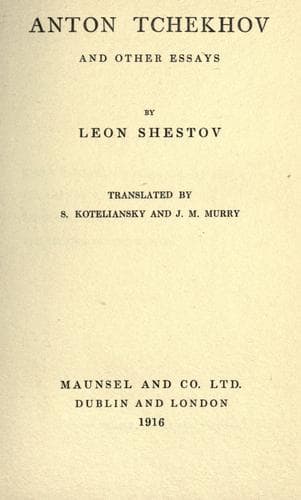
Chekhov, Anton Pavlovich, 1860-1904; Dostoyevsky, Fyodor, 1821-1881; Philosophy; Russian literature -- History and criticism
He does not want to confess his
sins, and even now on the threshold of another life he remains as he
was in youth. He desires neither paradise, nor bliss, nor heaven; he
asks God to give him back his health, and to put his money affairs in
order. 'I know there is much evil and many vices on earth. But I have
grown used to all that now, and besides I seldom leave my room. O God,
leave me here, but heal my infirmities, and spare me from want,' he
writes in one of his last poems. He derides the legends of the blissful
life of sinless souls in paradise. 'Sitting on the clouds and singing
psalms is a pastime quite unsuited to me.' He remembers the beautiful
Venus of the Louvre and praises her as in the days of youth. His poem,
_Das Hohelied,_ is a mixture of extreme cynicism, nobility, despair,
and incredible sarcasm. I do not know whether dying men have had such
thoughts as those which are expressed in this poem, but I am confident
that no one has expressed anything like them in literature. In Goethe's
_Prometheus_ there is nothing of the provocative, unshakable, calm
pride and the consciousness of his rights which inspired the author
of _Das Hohelied._ God, who created heaven and earth and man upon the
earth, is free to torment my body and soul to his fill, but I myself
know what I need and desire, I myself decide what is good and what is
bad. That is the meaning of this poem, and of all that Heine wrote in
the last years of his life. He knew as well as any one that according
to the doctrines of philosophy, ethics, and religion, repentance and
humility are the condition of the soul's salvation, the readiness even
with the last breath of life to renounce sinful desires. Nevertheless,
with his last breath he does not want to own the power over himself
of the age-old authorities of the world. He laughs at morality, at
philosophy, and at existing religions. The wise men think so, the wise
men want to live in their own way; let them think, let them live. But
who gave them the right to demand obedience from me? Can they have
the power to compel me to obedience? Listening to the words of the
dying man, shall we not repeat his question? Shall we not take one step
further? Heine is crushed, and if we may believe, as we have every
reason to believe what he tells us in his 'Song of Songs,' his painful
and terrible illness was the direct effect and consequence of his
manner of life. Does it mean that in the future, too (if future there
is), new persecutions await him, until the day when of his own accord
he will subscribe to the proclaimed and established morality? Have we
the right to suppose that there are powers somewhere in the universe
preoccupied with the business of cutting out all men, even down to
the last, after the same pattern? Perhaps Heine's contumacy points to
quite a different intention of the arbiters of destiny. Perhaps the
illness and torture prepared for those who fight against collars and
Public-domain text, read in full here on John Shaqi.
Reviews
Reviews
No reviews yet
Be the first to share your thoughts on this work.
Join the Discussion
Join the discussion
Sign in to leave a comment or review.
Sign InorCreate an account