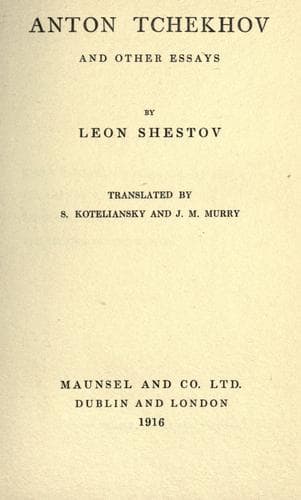
Chekhov, Anton Pavlovich, 1860-1904; Dostoyevsky, Fyodor, 1821-1881; Philosophy; Russian literature -- History and criticism
Stubbornly, sadly,
monotonously, during all the years of his literary activity, nearly a
quarter of a century long, Tchekhov was doing one thing alone: by one
means or another he was killing human hopes. Herein, I hold, lies the
essence of his creation. Hitherto it has been little spoken of. The
reasons are quite intelligible. In ordinary language what Tchekhov
was doing is called crime, and is visited by condign punishment. But
how can a man of talent be punished? Even Mihailovsky, who more than
once in his lifetime gave an example of merciless severity, did not
raise his hand against Tchekhov. He warned his readers and pointed
out the 'evil fire' which he had noticed in Tchekhov's eyes. But he
went no further. Tchekhov's immense talent overcame the strict and
rigorous critic. It may be, however, that Mihailovsky's own position
in literature had more than a little to do with the comparative
mildness of his sentence. The younger generation had listened to him
uninterruptedly for thirty years, and his word had been law. But
afterwards every one was bored with eternally repeating: 'Aristides
is just, Aristides is right.' The younger generation began to desire
to live and to speak in its own way, and finally the old master was
ostracised. There is the same custom in literature as in Terra del
Fuego. The young, growing men kill and eat the old. Mihailovsky
struggled with all his might, but he no longer felt the strength of
conviction that comes from the sense of right. Inwardly, he felt that
the young were right, not because they knew the truth--what truth did
the economic materialists know?--but because they were young and had
their lives before them. The rising star shines always brighter than
the setting, and the old must of their own will yield themselves up to
be devoured by the young. Mihailovsky felt this, and perhaps it was
this which undermined his former assurance and the firmness of his
opinion of old. True, he was still like Gretchen's mother in Goethe: he
did not take rich gifts from chance without having previously consulted
his confessor. Tchekhov's talent too was taken to the priest, by whom
it was evidently rejected as suspect; but Mihailovsky no longer had the
courage to set himself against public opinion. The younger generation
prized Tchekhov for his talent, his immense talent, and it was plain
they would riot disown him. What remained for Mihailovsky He attempted,
as I say, to warn them. But no one listened to him, and Tchekhov became
one of the most beloved of Russian writers.
Public-domain text, read in full here on John Shaqi.
Reviews
Reviews
No reviews yet
Be the first to share your thoughts on this work.
Join the Discussion
Join the discussion
Sign in to leave a comment or review.
Sign InorCreate an account