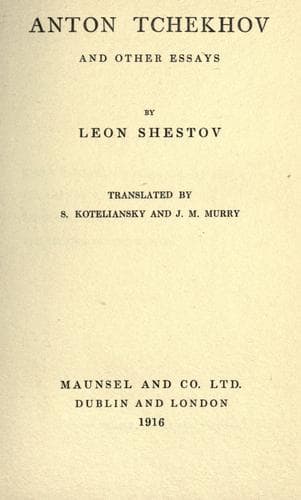
Chekhov, Anton Pavlovich, 1860-1904; Dostoyevsky, Fyodor, 1821-1881; Philosophy; Russian literature -- History and criticism
Yet the just Aristides was right this time too, as he was right when
he gave his warning against Dostoevsky. Now that Tchekhov is no more,
we may speak openly. Take Tchekhov's stories, each one separately, or
better still, all together; look at him at work. He is constantly,
as it were, in ambush, to watch and waylay human hopes. He will not
miss a single one of them, not one of them will escape its fate. Art,
science, love, inspiration, ideals--choose out all the words with which
humanity is wont, or has been in the past, to be consoled or to be
amused--Tchekhov has only to touch them and they instantly wither and
die. And Tchekhov himself faded, withered and died before our eyes.
Only his wonderful art did not die--his art to kill by a mere touch,
a breath, a glance, everything whereby men live and wherein they take
their pride. And in this art he was constantly perfecting himself, and
he attained to a virtuosity beyond the reach of any of his rivals in
European literature. Maupassant often had to strain every effort to
overcome his victim. The victim often escaped from Maupassant, though
crushed and broken, yet with his life. In Tchekhov's hands, nothing
escaped death.
II
I must remind my reader, though it is a matter of general knowledge,
that in his earlier work Tchekhov is most unlike the Tchekhov to whom
we became accustomed in late years. The young Tchekhov is gay and
careless, perhaps even like a flying bird. He published his work in
the comic papers. But in 1888 and 1889, when he was only twenty-seven
and twenty-eight years old, there appeared _The Tedious Story_ and the
drama _Ivanov,_ two pieces of work which laid the foundations of a
new creation. Obviously a sharp and sudden change had taken place in
him, which was completely reflected in his works. There is no detailed
biography of Tchekhov, and probably will never be, because there is no
such thing as a full biography--I, at all events, cannot name one.
Generally biographies tell us everything except what it is important
to know. Perhaps in the future it will be revealed to us with the
fullest details who was Tchekhov's tailor; but we shall never know what
happened to Tchekhov in the time which elapsed between the completion
of his story _The Steppe_ and the appearance of his first drama. If we
would know, we must rely upon his works and our own insight.
_Ivanov_ and _The Tedious Story_ seem to me the most autobiographical
of all his works. In them almost every line is a sob; and it is hard to
suppose that a man could sob so, looking only at another's grief. And
it is plain that his grief is a new one, unexpected as though it had
fallen from the sky. Here it is, it will endure for ever, and he does
not know how to fight against it.
Public-domain text, read in full here on John Shaqi.
Reviews
Reviews
No reviews yet
Be the first to share your thoughts on this work.
Join the Discussion
Join the discussion
Sign in to leave a comment or review.
Sign InorCreate an account