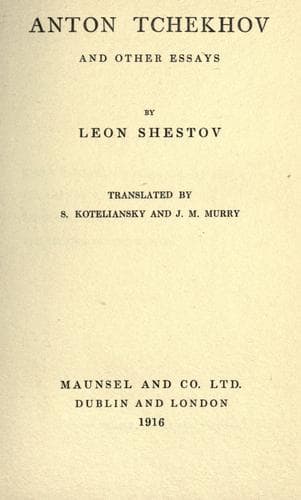
Chekhov, Anton Pavlovich, 1860-1904; Dostoyevsky, Fyodor, 1821-1881; Philosophy; Russian literature -- History and criticism
and everything is in its former place. Philosophy wants to be a science
at all costs. It is absolutely impossible for her to succeed in this;
but the price she has paid for the right to be called a science, is
not returned to her. She has waived the right of seeking that which
she needed wherever she would, and she is deprived of the right for
ever. But did she really need it? If you glance at contemporary German
philosophy you will say without hesitation that it was not needed at
all. Neither by mistake, nor even in pursuit of a new title, did she
renounce her great vocation: it has become an intolerable burden to
her. However hard it may be to confess, it is nevertheless indubitable
that the great secrets of the universe cannot be manifested with the
clarity and distinctness with which the visible and tangible world is
opened to us. Not only others--you will not even convince yourself of
your truth with the obviousness with which you can convince all men
without exception of scientific truths.
Revelations, if they do occur, are always revelations for an instant.
Mahomet--Dostoevsky explains--could only stay in paradise a very short
time, from half a second to five seconds, even if he succeeded in
falling into it. And Dostoevsky himself entered paradise only for an
instant. And here on earth, both of them lived for years, for tens of
years, and there seemed to be no end to the hell of earthly existence.
The hell was obvious, demonstrable; it could be fixed, exhibited,
_ad oculos._ But how could paradise be proven? How could one fix,
how express, those half-seconds of paradisic beatitude, which were
from the outside manifested in ugly and horrible epileptic fits with
convulsions, paroxysms, a foaming mouth, and sometimes an ill-omened
sudden fall, with the spilling of blood? Again, believe, if you will:
if you won't, don't. Surely a man who lives now in paradise, now in
hell sees life utterly differently from others. And he wants to think
that he is right, that his experience is of great value, that life is
not at all as it is described by men of different experience and more
limited emotions. How desperately did Dostoevsky desire to persuade all
men of his rightness, how stubbornly he used to demonstrate, and how
angry he was made by the consciousness that lived in the depths of his
soul that he was impotent to prove anything. But a fact remains a fact.
Perhaps epileptics and madmen know things of which normal men have
not even the remotest presentiment, but it is not vouchsafed to them
to communicate their knowledge to others, or to prove it. And there
is a universal knowledge which is the very object of philosophical
seeking, with which one may commune, but which by its very essence
cannot be communicated to all, that is, cannot be turned into verified
and demonstrable universal truths. To renounce this knowledge in order
that philosophy should have the right to be called a science! At times
men acted thus.
Public-domain text, read in full here on John Shaqi.
Reviews
Reviews
No reviews yet
Be the first to share your thoughts on this work.
Elsewhere in the archive
Join the Discussion
Join the discussion
Sign in to leave a comment or review.
Sign InorCreate an account