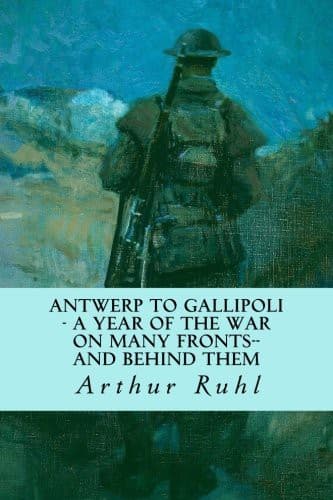
Antwerp to Gallipoli: A Year of the War on Many Fronts—and Behind ThemRuhl, Arthur
History
Antwerp to Gallipoli: A Year of the War on Many Fronts—and Behind Them
Ruhl, Arthur
World War, 1914-1918 -- Personal narratives
True or not, it was one of those things that get believed. Verses were
written about it and pictures made of it all over Paris--presently it
would be history. And this girl, true child of the asphalt, was
flinging it at them, holding the hearts of these broad-faced mothers in
the hollow of her hand. She would sing one verse, pause, and sell
copies of the song, then put a hand to her hoarse throat and sing again.
The music was not sold with the song, and it was rather difficult--a
mournful sort of recitative with sudden shifts into marching rhythm--and
so the people sang the words over and over with her until they had
almost learned the tune. You can imagine how a Frenchman--he was a young
fellow, who lived in a rear tenement over on the other side of
Montmartre--would write that song. The little boy, who was going to
"free his brothers back there in Alsace" when he grew up, playing
soldier--"Joyeux, il murmurait: Je suis petit, en somme, Mais viendra
bien le jour, ou je serai un homme, Ardeat! Vaillanti..."--the
Prussians--monstres odieux--smashing into the village, the cry "Maman!
Maman!"--and after each verse a pause, and slowly and lower down, with
the crowd joining in, "Petit--enfant" ("Little boy, close your big blue
eyes, for the bandits are hideous and cruel, and they will kill you if
they read your brave thoughts") "ferme tes grands yeux bleus."
The violins mixed with the voices of the market-women, crying their
artichokes and haricots, and above them rang--"Ardent! Vaillant! ..."
Audit might have been the voice of Paris itself, lying down there in her
mist, Paris of lost Alsace and hopeless revanche, of ardor and charm
crushed once, as they might be again, as the voice of that pale girl in
black, with her air of coming from lights and cigarette smoke, and of
these simple mothers rose above the noise of the street, half dirge,
half battle-cry, while out beyond somewhere the little soldiers in red
breeches were fighting, and the fate of France hung in the balance, that
morning.
Chapter III
After The Marne
At the end of the village the road climbed again from the ravine and
emerged on open fields. A wall of timber, dark and impenetrable as the
woods round an old chateau, rose at the farther end of these fields--the
road cutting through it like a tunnel--and on the brow of the ravine,
commanding the road and the little plain, was a line of trenches. Here
evidently they had fought.
We walked on down the road. Below the northern horizon, where they were
fighting now along the Aisne, rolled the sullen thunder of artillery, as
it had been rolling since daylight. And the autumn wind, cold with the
week of equinoctial rain, puffing out of thickets and across ravines,
brought, every now and then, the horrible odor of death.
Public-domain text, read in full here on John Shaqi.
Reviews
Reviews
No reviews yet
Be the first to share your thoughts on this work.
Join the Discussion
Join the discussion
Sign in to leave a comment or review.
Sign InorCreate an account