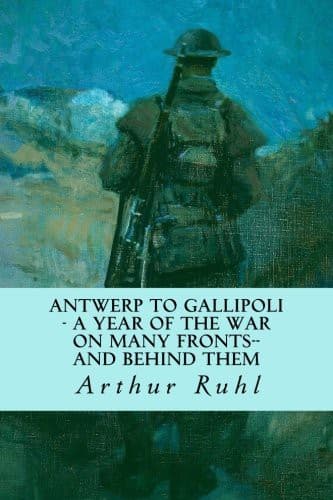
Antwerp to Gallipoli: A Year of the War on Many Fronts—and Behind ThemRuhl, Arthur
History
Antwerp to Gallipoli: A Year of the War on Many Fronts—and Behind Them
Ruhl, Arthur
World War, 1914-1918 -- Personal narratives
Ahead, to the right, one caught the glint of a French infantry's red
trousers. A man was lying there, face downward, on the field. Then
across the open space appeared another--and another--they were scattered
all over that field, bright as the red poppies which were growing in the
stubble and as still. They were in various positions. One lay on his
back, with one knee raised like a man day-dreaming and looking up at the
sky. Another was stretched stiff, with both hands clinched over his
chest. One lay in the ditch close beside us, his head jammed into the
muddy bank just as he had dived there in falling; another gripped a cup
in one hand and a spoon in the other, as if, perhaps, he might have
tried to feed himself in the long hours after the battle rolled on and
left them there.
All these were French, but just at the edge of the thick timber was a
heap--one could scarcely say of Germans, so utterly did the gray, sodden
faces and sodden, gray uniforms merge into anonymity. A squad of French
soldiers appeared at a turn in the road. Two officers rode beside them,
and they were just moving off across the fields carrying shovels instead
of rifles. Looking after them, beyond the belt of timber, one could see
other parties like theirs on the distant slopes to the left, and here
and there smoke. Two more French soldiers appeared pushing a
wheelbarrow filled with cast-off arms. With the boyish good nature
which never seems to desert these little men in red and blue, they
stopped and offered us a few clips of German cartridges. They were
burying their own men, they said, burning the Germans. The dead had
been lying here for nearly a fortnight now while the battle line rolled
northward, clear across France.
We turned back toward Crepy, passing again through the shattered village
of Betz. For three days it had been the centre of a battle, the two
forces lying outside it and shelling each other across the town. The
main street, now full of French soldiers, was in ruins, the church on
the edge of the ravine smashed and gaping, and a few peasant women stood
about, arms folded patiently, telling each other over and over again
what they had seen.
Public-domain text, read in full here on John Shaqi.
Reviews
Reviews
No reviews yet
Be the first to share your thoughts on this work.
Join the Discussion
Join the discussion
Sign in to leave a comment or review.
Sign InorCreate an account