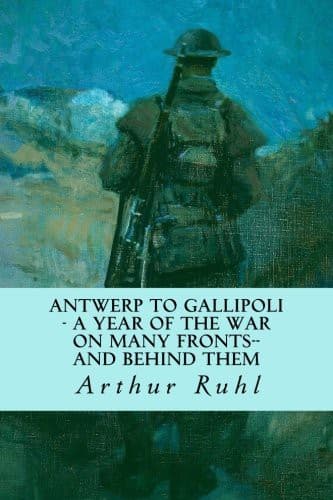
Antwerp to Gallipoli: A Year of the War on Many Fronts—and Behind Them — John Shaqi
Antwerp to Gallipoli: A Year of the War on Many Fronts—and Behind ThemRuhl, Arthur
History
Antwerp to Gallipoli: A Year of the War on Many Fronts—and Behind Them
Ruhl, Arthur
World War, 1914-1918 -- Personal narratives
There wasn't much sleep for any one that night. The bombardment kept on
until morning, lulled slightly, as if the enemy might be taking
breakfast, then it continued into the, next day. And now the city--a
busy city of nearly four hundred thousand people--emptied itself in
earnest. Citizens and soldiers, field-guns, motor-trucks, wheelbarrows,
dog-carts, hay-ricks, baby-carriages, droves of people on foot, all
flowing down to the Scheldt, the ferries, and the bridge. They poured
into coal barges, filling the yawning black holes as Africans used to
fill slave-ships, into launches and tugs, and along the roads leading
down the river and southwestward toward Ostend.
One thought with a shudder of what would happen if the Germans dropped a
few of their shells into that helpless mob, and it is only fair to
remember that they did not, although retreating Belgian soldiers were a
part of it, and one of the German aeroplanes, a mere speck against the
blue, was looking calmly down overhead. Nor did they touch the
cathedral, and their agreement not to shell any of the buildings
previously pointed out on a map delivered to them through the American
Legation seemed to be observed.
Down through that mass of fugitives pushed a London motor-bus ambulance
with several wounded British soldiers, one of them sitting upright,
supporting with his right hand a left arm, the biceps, bound in a
blood-soaked tourniquet, half torn away. They had come in from the
trenches, where their comrades were now waiting, with their helpless
little rifles, for an enemy, miles away, who lay back at his ease and
pounded them with his big guns. I asked them how things were going, and
they said not very well. They could only wait until the German
aeroplanes had given the range and the trenches became too hot, then
fall back, dig themselves in, and play the same game over again.
Following them was a hospital-service motor-car, driven by a Belgian
soldier and in charge of a young British officer. It was his present
duty to motor from trench to trench across the zone of fire, with the
London bus trailing behind, and pick up wounded. It wasn't a
particularly pleasant job, he said, jerking his head toward the distant
firing, and frankly he wasn't keen about it. We talked for some time,
every one talked to every one else in Antwerp that morning, and when he
started out again I asked him to give me a lift to the edge of town.
Public-domain text, read in full here on John Shaqi.
Reviews
Reviews
No reviews yet
Be the first to share your thoughts on this work.
Join the Discussion
Join the discussion
Sign in to leave a comment or review.
Sign InorCreate an account