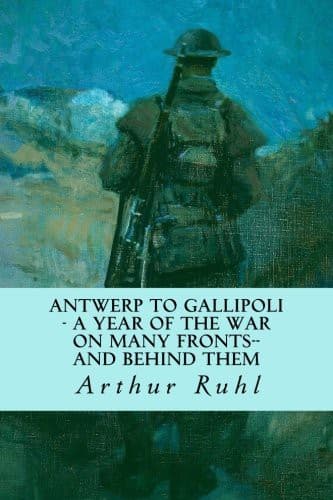
Antwerp to Gallipoli: A Year of the War on Many Fronts—and Behind ThemRuhl, Arthur
History
Antwerp to Gallipoli: A Year of the War on Many Fronts—and Behind Them
Ruhl, Arthur
World War, 1914-1918 -- Personal narratives
Quickly we raced through the Place de Meir and the deserted streets of
the politer part of Antwerp, where, the night before, most of the shells
had fallen. We went crackling over broken glass, past gaping cornices
and holes in the pavement, five feet across and three feet deep, and
once passed a house quietly burning away with none to so much as watch
the fire. The city wall, along which are the first line of forts, drew
near, then the tunnel passing under it, and we went through without
pausing and on down the road to Malines. We were beyond the town now,
bowling rapidly out into the flat Belgian country, and, clinging there
to the running-board with the October wind blowing quite through a thin
flannel suit, it suddenly came over me that things had moved very fast
in the last five minutes, and that all at once, in some unexpected
fashion, all that elaborate barrier of laissez-passers, sauf-conduits,
and so on, had been swept aside, and, quite as if it were the most
ordinary thing in the world, I was spinning out to that almost mythical
"front."
Front, indeed! It was two fronts. There was an explosion just behind
us, a hideous noise overhead, as if the whole zenith had somehow been
ripped across like a tightly stretched piece of silk, and a shell from
the Belgian fort under which we had just passed went hurtling down long
aisles of air--farther--farther--to end in a faint detonation miles
away.
Out of sight in front of us, there was an answering thud, and--
"Tzee-ee-ee-er-r-r-ong!"--a German shell had gone over us and burst
behind the Belgian fort. Under this gigantic antiphony the motor-car
raced along, curiously small and irrelevant on that empty country road.
We passed great holes freshly made, neatly blown out of the macadam,
then a dead horse. There were plenty of dead horses along the roads in
France, but they had been so for days. This one's blood was not yet
dry, and the shell that had torn the great rip in its chest must have
struck here this morning.
We turned into the avenue of trees leading up to an empty chateau, a
field-hospital until a few hours before. Mattresses and bandages
littered the deserted room, and an electric chandelier was still
burning. The young officer pointed to some trenches in the garden. "I
had those dug to put the wounded in in case we had to hold the place,"
he said. "It was getting pretty hot."
Public-domain text, read in full here on John Shaqi.
Reviews
Reviews
No reviews yet
Be the first to share your thoughts on this work.
Join the Discussion
Join the discussion
Sign in to leave a comment or review.
Sign InorCreate an account