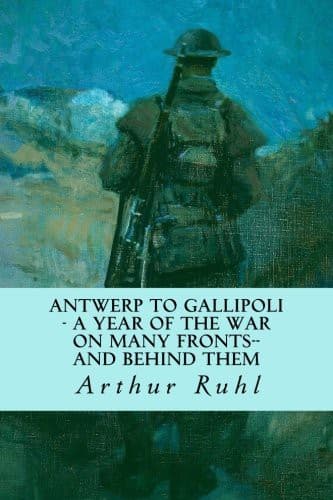
Antwerp to Gallipoli: A Year of the War on Many Fronts—and Behind ThemRuhl, Arthur
History
Antwerp to Gallipoli: A Year of the War on Many Fronts—and Behind Them
Ruhl, Arthur
World War, 1914-1918 -- Personal narratives
Yet not one of the youngest and the greenest showed the least
nervousness as they waited there in that melancholy little orchard under
the incessant scream of shells. That unshakable British coolness, part
sheer pluck, part a sort of lack of imagination, perhaps, or at least of
"nerves," left them as calm and casual as if they were but drilling on
the turf of Hyde Park. And with it persisted that almost equally
unshakable sense of class, that touching confidence in one's superiors--
the young clerk's or mechanic's inborn conviction that whatever that
smart, clean-cut, imperturbable young officer does and says must
inevitably be right--at least, that if he is cool and serene you must,
if the skies fall, be cool and serene too.
We met one young fellow as we walked through an empty lateral leading to
a bomb-proof prepared for wounded, and the ambulance officer asked him
sharply how things had been going that morning.
"Oh, very well, sir," he said with the most respectful good humor,
though a shell bursting just then a stone's throw beyond the orchard
made both of us duck our heads. "A bit hot, sir, about nine o'clock,
but only one man hurt. They do seem to know just where we are, sir; but
wait till their infantry comes up--we'll clean them out right enough,
sir."
And, if he had been ordered to stay there and hold the trench alone, one
could imagine him saying, in that same tone of deference and chipper
good humor, "Yes, sir; thank you, sir," and staying, too, till the cows
came home.
We motored down the line to another trench--this one along a road with
fields in front and, about a couple of hundred yards behind, a clump of
trees which masked a Belgian battery. The officer here, a tall,
upstanding, gravely handsome young man, with a deep, strong, slightly
humorous voice, and the air of one both born to and used to command--the
best type of navy man--came over to meet us, rather glad, it seemed, to
see some one. The ambulance officer had just started to speak when
there was a roar from the clump of trees, at the same instant an
explosion directly overhead, and an ugly chunk of iron--a bit of broken
casing from a shrapnel shell--plunged at our very feet. The shell had
been wrongly timed and exploded prematurely.
"I say!" the lieutenant called out to a Belgian officer standing not far
away, "can't you telephone over to your people to stop that? That's the
third time we've been nearly hit by their shrapnel this morning. After
all"--he turned to us with the air of apologizing somewhat for his
display of irritation--"it's quite annoying enough here without that,
you know."
It was, indeed, annoying--very. The trenches were not under fire in the
sense that the enemy were making a persistent effort to clear them out,
but they were in the zone of fire, their range was known, and there was
no telling, when that distant boom thudded across the fields, whether
that particular shell might be intended for them or for somebody's house
in town.
Public-domain text, read in full here on John Shaqi.
Reviews
Reviews
No reviews yet
Be the first to share your thoughts on this work.
Join the Discussion
Join the discussion
Sign in to leave a comment or review.
Sign InorCreate an account