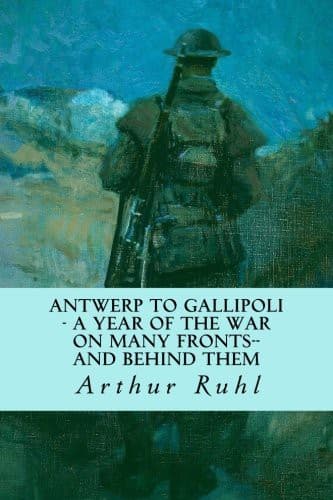
Antwerp to Gallipoli: A Year of the War on Many Fronts—and Behind ThemRuhl, Arthur
History
Antwerp to Gallipoli: A Year of the War on Many Fronts—and Behind Them
Ruhl, Arthur
World War, 1914-1918 -- Personal narratives
There was nothing here now, however, and, followed by the London bus
with its obedient enlisted men doing duty as ambulance orderlies, we
motored a mile or so farther on to the nearest trench. It was in an
orchard beside a brick farmhouse with a vista in front of barbed-wire
entanglement and a carefully cleaned firing field stretching out to a
village and trees about half a mile away. They had looked very
interesting and difficult, those barbed-wire mazes and suburbs,
ruthlessly swept of trees and houses, when I had seen the Belgians
preparing for the siege six weeks before, and they were to be of about
as much practical use now as pictures on a wall.
There are, it will be recalled, three lines of forts about Antwerp--the
inner one, corresponding to the city's wall; a middle one a few miles
farther out, where the British now were; and the outer line, which the
enemy had already passed. Their artillery was hidden far over behind
the horizon trees, and the British marines and naval-reserve men who
manned these trenches could only wait there, rifle in hand, for an enemy
that would not come, while a captive balloon a mile or two away to the
eastward and an aeroplane sailing far overhead gave the ranges, and they
waited for the shrapnel to burst. The trenches were hasty affairs,
narrow and shoulder-deep, very like trenches for gas or water pipes, and
reasonably safe except when a shell burst directly overhead. One had
struck that morning just on the inner rim of the trench, blown out one
of those crater-like holes, and discharged all its shrapnel backward
across the trench and into one of the heavy timbers supporting a
bombproof roof. A raincoat hanging to a nail in this timber was
literally shot to shreds. "That's where I was standing," said the young
lieutenant in command, pointing with a dry smile to a spot not more than
a yard from where the shell had burst.
Half a dozen young fellows, crouched there in the bomb-proof, looked out
at us and grinned. They were brand-new soldiers, some of them, boys
from the London streets who had answered the thrilling posters and
signs, "Your King and Country Need You," and been sent on this ill-fated
expedition for their first sight of war. The London papers are talking
about it as I am writing this--how this handful of nine thousand men,
part of them recruits who scarcely knew one end of a rifle from another,
were flung across the Channel on Sunday night and rushed up to the front
to be shot at and rushed back again. I did not know this then, but
wondered if this was what they had dreamed of--squatting helplessly in a
ditch until another order came to retire--when they swung through the
London streets singing "It's a long, long way to Tipperary" two months
before.
Public-domain text, read in full here on John Shaqi.
Reviews
Reviews
No reviews yet
Be the first to share your thoughts on this work.
Join the Discussion
Join the discussion
Sign in to leave a comment or review.
Sign InorCreate an account