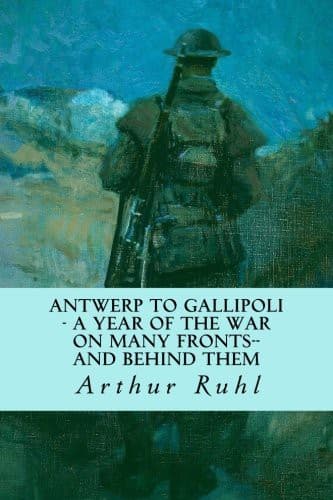
Antwerp to Gallipoli: A Year of the War on Many Fronts—and Behind Them — John Shaqi
Antwerp to Gallipoli: A Year of the War on Many Fronts—and Behind ThemRuhl, Arthur
History
Antwerp to Gallipoli: A Year of the War on Many Fronts—and Behind Them
Ruhl, Arthur
World War, 1914-1918 -- Personal narratives
It was such a progress as one might make in some fantastic nightmare--as
the hero of some eerie piece of fiction about the Last Man in the World.
Street after street, with doors locked, shutters closed, sandbags,
mattresses, or little heaps of earth piled over cellar windows; streets
in which the only sound was that of one's own feet, where the loneliness
was made more lonely by some forgotten dog cringing against the closed
door and barking nervously as one hurried past.
Here, where most of the shells had fallen the preceding night, nearly
all the houses were empty. Yet occasionally one caught sight of faces
peering up from basement windows or of some stubborn householder
standing in his southern doorway staring into space. Once I passed a
woman bound away from, instead of toward, the river with her big bundle;
and once an open carriage with a family in it driving, with peculiarly
Flemish composure, toward the quay, and as I hurried past the park,
along the Avenue Van Dyck--where fresh craters made by exploding shells
had been dug in the turf--the swans, still floating on the little lake,
placidly dipped their white necks under water as if it were a quiet
morning in May.
Now and then, as the shell's wail swung over its long parabola, there
came with the detonation, across the roofs, the rumble of falling
masonry. Once I passed a house quietly burning, and on the pavement
were lopped-off trees. The impartiality with which those far-off
gunners distributed their attentions was disconcerting. Peering down
one of the up-and-down streets before crossing it, as if a shell were an
automobile which you might see and dodge, you would shoot across and,
turning into a cosey little side street, think to yourself that here at
least they had not come, and then promptly see, squarely in front,
another of those craters blown down through the Belgian blocks.
Presently I found myself under the trees of the Boulevard Leopold, not
far from the British hospital, and recalled that it was about time that
promise was made good. It was time indeed, and help with lifting they
needed very literally. The order had just come to leave the building,
bringing the wounded and such equipment as they could pack into half a
dozen motor-buses and retire--just where, I did not hear--in the
direction of Ghent. As I entered the porte-cochere two poor wrecks of
war were being led out by their nurses--more men burned in the powder
explosion at Waelhem, their seared faces and hands covered with oil and
cotton just as they had been lifted from bed.
The phrase "whistle of shells" had taken on a new reality since
midnight. Now one was to learn something of the meaning of those equally
familiar words, "they succeeded in saving their wounded, although under
heavy fire."
Public-domain text, read in full here on John Shaqi.
Reviews
Reviews
No reviews yet
Be the first to share your thoughts on this work.
Join the Discussion
Join the discussion
Sign in to leave a comment or review.
Sign InorCreate an account