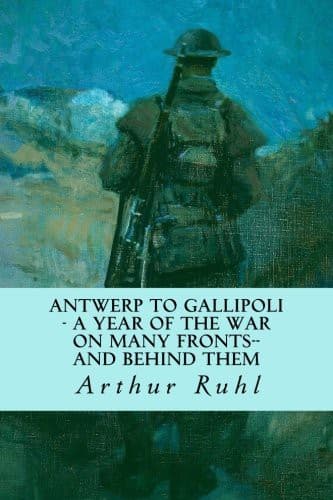
Antwerp to Gallipoli: A Year of the War on Many Fronts—and Behind ThemRuhl, Arthur
History
Antwerp to Gallipoli: A Year of the War on Many Fronts—and Behind Them
Ruhl, Arthur
World War, 1914-1918 -- Personal narratives
None of the wounded could walk, none dress himself; most of them in
ordinary times would have lain where they were for weeks. There were
fractured legs not yet set, men with faces half shot away, men half out
of their heads, and all these had to be dressed somehow, covered up,
crowded into or on top of the buses, and started off through a city
under bombardment toward open country which might already be occupied by
the enemy.
Bundles of uniforms, mud-stained, blood-stained, just as they had come
from the trenches, were dumped out of the storeroom and distributed, hit
or miss.
British "Tommies" went out as Belgians, Belgians in British khaki; the
man whose broken leg I had lifted the day before we simply bundled in
his bed blankets and set up in the corner of a bus. One healthy-looking
Belgian boy, on whom I was trying to pull a pair of British trousers,
seemed to have nothing at all the matter with him, until it presently
appeared that he was speechless and paralyzed in both left arm and left
leg. And while we were working, an English soldier, shot through the
jaw and throat, sat on the edge of his bed, shaking with a hideous,
rattling cough.
The hospital was in a handsome stone building, in ordinary times a club,
perhaps, or a school; a wide, stone stairway led up the centre, and
above it was a glass skylight. This central well would have been a
charming place for a shell to drop into, and one did drop not more than
fifty feet or so away, in or close to the rear court. A few yards down
the avenue another shell hit a cornice and sent a ton or so of masonry
crashing down on the sidewalk. Under conditions like these the nurses
kept running up and down that staircase during the endless hour or two
in which the wounded were being dressed and carried on stretchers to the
street. They stood by the buses making their men comfortable, and when
the first buses were filled they sat in the open street on top of them,
patiently waiting, as calm and smiling as circus queens on their gilt
chariots. The behavior of the men in the trenches was cool enough, but
they at least were fighting men and but taking the chance of war. These
were civilian volunteers, they had not even trenches to shelter them,
and it took a rather unforeseen and difficult sort of courage to leave
that fairly safe masonry building and sit smiling and helpful on top of
a motor-bus during a wait of half an hour or so, any second of which
might be one's last. There was an American nurse there, a tall, radiant
girl, whom they called, and rightly, "Morning Glory," who had been
introduced to me the day before because we both belonged to that curious
foreign race of Americans. What her name was I haven't the least idea,
and if we were to meet to-morrow, doubtless we should have to be
carefully presented over again, but I remember calling out to her,
"Good-by, American girl!" as we passed in the hall during the last
Public-domain text, read in full here on John Shaqi.
Reviews
Reviews
No reviews yet
Be the first to share your thoughts on this work.
Join the Discussion
Join the discussion
Sign in to leave a comment or review.
Sign InorCreate an account