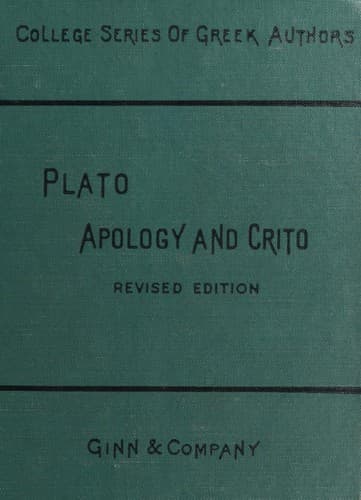
Classical literature; Philosophy, Ancient; Socrates, 470 BC-399 BC
Let us reflect in another way, and we shall see that there is great
reason to hope that death is a good; for one of two things—either death
is a state of nothingness and utter unconsciousness, or, as men say,
there is a change and migration of the soul from this world to another.
Now if you suppose that there is no consciousness, but a sleep like the
sleep of him who is undisturbed even by dreams, death will be an
unspeakable gain. For if a person were to select the night in which his
sleep was undisturbed even by dreams, and were to compare with this the
other days and nights of his life, and then were to tell us how many
days and nights he had passed in the course of his life better and more
pleasantly than this one, I think that any man, I will not say a
private man, but even the great king will not find many such days or
nights, when compared with the others. Now if death be of such a
nature, I say that to die is gain; for eternity is then only a single
night. But if death is the journey to another place, and there, as men
say, all the dead abide, what good, O my friends and judges, can be
greater than this? If indeed when the pilgrim arrives in the world
below, he is delivered from the professors of justice in this world,
and finds the true judges who are said to give judgment there, Minos
and Rhadamanthus and Aeacus and Triptolemus, and other sons of God who
were righteous in their own life, that pilgrimage will be worth making.
What would not a man give if he might converse with Orpheus and Musaeus
and Hesiod and Homer? Nay, if this be true, let me die again and again.
I myself, too, shall have a wonderful interest in there meeting and
conversing with Palamedes, and Ajax the son of Telamon, and any other
ancient hero who has suffered death through an unjust judgment; and
there will be no small pleasure, as I think, in comparing my own
sufferings with theirs. Above all, I shall then be able to continue my
search into true and false knowledge; as in this world, so also in the
next; and I shall find out who is wise, and who pretends to be wise,
and is not. What would not a man give, O judges, to be able to examine
the leader of the great Trojan expedition; or Odysseus or Sisyphus, or
numberless others, men and women too! What infinite delight would there
be in conversing with them and asking them questions! In another world
they do not put a man to death for asking questions: assuredly not. For
besides being happier than we are, they will be immortal, if what is
said is true.
Public-domain text, read in full here on John Shaqi.
Reviews
Reviews
No reviews yet
Be the first to share your thoughts on this work.
Join the Discussion
Join the discussion
Sign in to leave a comment or review.
Sign InorCreate an account