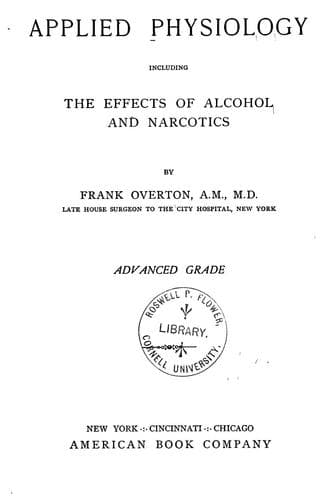
Applied Physiology, Including the Effects of Alcohol and Narcotics — John Shaqi
Applied Physiology, Including the Effects of Alcohol and NarcoticsOverton, Frank
Science
Applied Physiology, Including the Effects of Alcohol and Narcotics
Overton, Frank
Physiology
=103. How air gets into the blood.=--After the blood has been around the
body through the arteries and capillaries and veins, the heart sends
every drop to the lungs before it sends it out to feed the cells again.
The blood flows through little capillaries upon the sides of the air
sacs. There the red blood cells take up some of the air, and carry it
with them. When they have a load of air, they become of a brighter red
color. The blood in the arteries on its way to the cells is bright red.
=104. How the cells get air.=--When the blood reaches the capillaries
around the cells of the body, the red blood cells give up some of the
air to the cells. Thus each cell of the body gets some air, and so it
breathes. The cells cannot reach the air themselves, and so the red
blood cells bring it to them. We breathe so as to supply the cells
with air.
=105. What burning is.=--When meat is put into a hot stove it quickly
burns, and passes off in smoke, and leaves only a little ashes. The
ashes are the mineral parts of the meat. If the fire is very hot, you
cannot see the smoke. The burning of the meat makes heat. Heat in a
steam engine makes the machine do work.
Every fire must have plenty of air. If air is shut off, the fire goes
out. When meat burns, the air unites with the meat and makes smoke, and
ashes, and gives out heat. Air unites with something in every fire.
=106. Burning inside the body.=--In every part of a man's body a very
slow fire is always burning. The blood brings to the cells food from
the intestine, and air from the lungs. The food and air join in a
burning. The smoke goes back to the blood and is carried to the lungs,
and breathed out with the breath. The ashes, also, go back to the
blood, and are carried away by the skin and kidneys. The burning makes
no flame or light for it goes on very slowly. You cannot see the
smoke, but you can feel the warmth of the burning. Some of the heat is
turned to power, and gives the body strength to do work. The body is
like a steam engine. It burns up all its food.
=107. How the body is warmed.=--The body is warmed by the slow burning
in the cells. This burning keeps the body always at the same warmth.
On a hot summer's day you feel warmer than on a cold snowy morning.
But your body is no warmer. Only your skin is warmer.
If the skin is warm, the whole body feels warm, but if the skin is
cold, the whole body feels cold. On a hot summer's day the heat is
kept in the skin, and we feel warm. On a cold winter's day a great
deal of heat passes off from the skin, and we feel cold. Yet our
bodies have the same warmth in winter as in summer.
=108. How the sweat keeps us cool.=--When your hands or feet are wet,
they are cold. On a hot summer's day, your body becomes wet with
sweat. This cools the body as if water were poured over it. So
sweating keeps you from getting too warm, and from being sunstruck.
Public-domain text, read in full here on John Shaqi.
Reviews
Reviews
No reviews yet
Be the first to share your thoughts on this work.
Join the Discussion
Join the discussion
Sign in to leave a comment or review.
Sign InorCreate an account