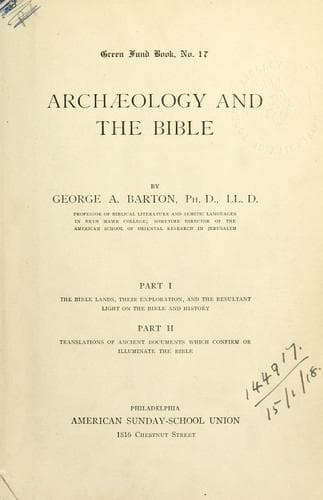
Archæology and the BibleBarton, George A. (George Aaron)
Religion
Archæology and the Bible
Barton, George A. (George Aaron)
Bible -- Antiquities; Egypt -- Antiquities; Middle East -- Antiquities
Those who hold either of these views of archæology will find in this book
much that will accord with their expectations, but much also that will
seem to them irrelevant. In Part I, Chapters IV, VI-XII deal with
antiquities, their discovery, and the light which these shed upon the
inspired page, for antiquarianism is a part of archæology. Portions of
Part I are devoted to the discovery of inscribed objects; in Part II the
reader will find a full presentation of the bearing of these upon the
different parts of the Sacred Volume. Those who hold the second of the
views mentioned above will not, therefore, be disappointed.
Neither of the views mentioned corresponds, however, with the limits of
archæology. Archæology is “that branch of knowledge which takes cognizance
of past civilizations, and investigates their history in all fields, by
means of the remains of art, architecture, monuments, inscriptions,
literature, language, implements, customs, and all other examples which
have survived.”[1] This definition is accepted by the writer of this work
and has guided him in the preparation of the following pages. It has, of
course, been impossible in one volume to deal adequately with the
antiquities and the ancient documents and to treat fully the history of
the civilizations of the Biblical countries, but an endeavor has been made
to place the reader in possession of an intelligent point of view with
reference to these things. As the physical structure of a country
determines to a large degree the nature of its buildings, the utensils
employed by its inhabitants, their writing materials, and their relations
with other peoples,--as well as the way the objects were preserved from
ancient to modern times,--brief descriptions of the physical features of
Egypt, Mesopotamia, and Palestine, the three most prominent of Biblical
countries, have been introduced.
Our knowledge of the early history of Egypt and Babylonia has come almost
wholly from archæological exploration; it has seemed fitting, therefore,
to introduce in Part I, Chapter I, § 6, and Chapter II, § 6, brief
sketches of the history of these countries. This appeared all the more
necessary since the inhabitants of these two countries worked out, in
advance of any other peoples, the initial problems of civilization.
Palestine borrowed from them both, so that it is impossible to understand
the history and archæology of Palestine apart from Egyptian and Babylonian
antecedents. Whenever it is possible the reader should supplement these
sketches by reference to the larger works cited in the notes.
Public-domain text, read in full here on John Shaqi.
Reviews
Reviews
No reviews yet
Be the first to share your thoughts on this work.
Join the Discussion
Join the discussion
Sign in to leave a comment or review.
Sign InorCreate an account