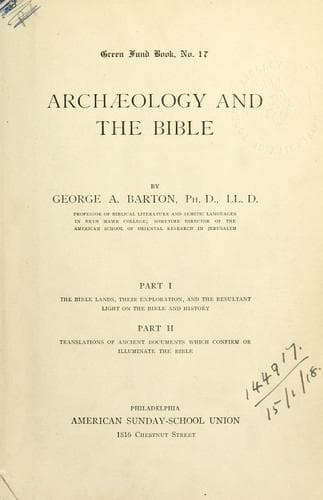
Archæology and the BibleBarton, George A. (George Aaron)
Religion
Archæology and the Bible
Barton, George A. (George Aaron)
Bible -- Antiquities; Egypt -- Antiquities; Middle East -- Antiquities
In the seventeenth century European travelers began to bring home Egyptian
antiquities. In 1683 a specimen of Egyptian art was presented to the
Ashmolean Museum at Oxford. In the eighteenth century R. Pococke
(1704-1765) and F. L. Norden (1704-1742) described a number of Egyptian
ruins and identified a number of the sites mentioned by classical authors.
Pococke was an Englishman and Norden a Dane. Others, like the explorer
Bruce, who was seeking the sources of the Nile (1768-1773), participated
to some extent in the work.
No systematic examination of the antiquities was made, however, until the
time of Napoleon I. When Napoleon invaded Egypt in 1798, he was
accompanied by an army of eminent scholars and artists, nearly a hundred
strong, and although in the settlement with England, which followed in
1802, the French were compelled to surrender their archæological treasures
to Great Britain, they were permitted to publish the results of their
observations and explorations. The publication of these advanced slowly,
but between 1809 and 1822 the great work, consisting of one volume of
introduction, three volumes of plates, and three volumes of texts, was
given to the world. In these volumes the antiquities from the First
Cataract to Alexandria were systematically described, and many of them
were reproduced in magnificent water-color illustrations. As the
nineteenth century progressed, additional discoveries were made, partly by
the labors of such scientists as Lepsius and Mariette, and partly through
the rifling of tombs by natives, who often sold their finds to Europeans.
Since Egypt passed under English control, exploration has been fostered by
the government, and English, French, German, Italian, and American
explorers have taken part in it. The tombs of many of the ancient
Pharaohs, the mummies of a considerable number of them, all sorts of
implements and household furniture, have been discovered, as well as a
great variety of historical, literary, religious, and business documents.
Within the last twenty years a series of tombs of a previously unknown
type has been discovered. The bodies buried in these tombs did not lie on
the back as the ordinary Egyptian mummy does, but on the side, with the
knees drawn up to the chin. It was at first thought that these tombs were
the work of a new race of men who had invaded Egypt at some time in the
historical period, but further study indicates that they are the tombs of
the early Egyptians from whom the Egyptians known to history were
descended.
Public-domain text, read in full here on John Shaqi.
Reviews
Reviews
No reviews yet
Be the first to share your thoughts on this work.
Join the Discussion
Join the discussion
Sign in to leave a comment or review.
Sign InorCreate an account