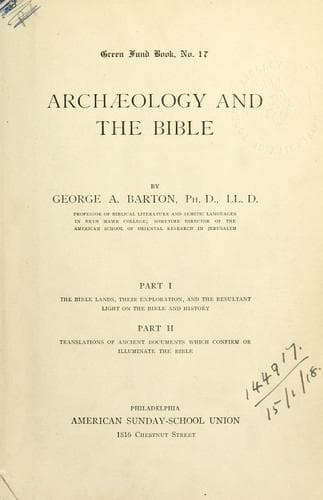
Archæology and the BibleBarton, George A. (George Aaron)
Religion
Archæology and the Bible
Barton, George A. (George Aaron)
Bible -- Antiquities; Egypt -- Antiquities; Middle East -- Antiquities
The laws on divorce (§§ 138-141) are really in advance of the one Biblical
law on the subject (Deut. 24:1-4). The law in Deuteronomy permits a
husband to put away a wife, who in any way does not please him, without
alimony, while to the wife no privilege of initiating divorce proceedings
is granted at all. The Babylonian laws secure to the divorced woman a
maintenance, and, while by no means according her equal rights with the
man, provide (§ 142) that she may herself initiate the proceedings for
divorce. The ordeal must have been an unpleasant one, but in Israel’s law
a woman had no such rights.[468]
The law concerning adultery with a daughter-in-law (§ 155) is identical in
purpose and severity with Lev. 20:12. The laws in §§ 157, 158, which
prohibit immorality with one’s mother or the chief wife of one’s father,
just touch upon the great subject of incest and the prohibited degrees of
marriage which are treated at considerable length in Lev. 18:6-18; 20:11,
19-21, and Deut. 22:30. The Babylonian laws touch but two specific cases,
which may be said to be covered by Deut. 22:30, while the laws of
Leviticus treat the whole subject of the prohibited degrees of marriage in
a broad and comprehensive way. The main idea pervading Leviticus is
holiness. Israel is to be kept free from the pollution of incest in any
form. The religious motive exhibited here is foreign to the Babylonian
code.
Inheritance
§ 162. It a man takes a wife and she bears him children and that woman
dies, her father may not lay claim to her dowry. Her dowry belongs to
her children.
§ 163. If a man takes a wife and she does not present him with
children and that woman dies; if his father-in-law returns unto him
the marriage-settlement, which that man brought to the house of the
father-in-law, unto the dowry of that woman her husband may not lay
claim. Her dowry belongs to the house of her father.
§ 164. But if his father-in-law does not return the
marriage-settlement unto him, he shall deduct from her dowry the
amount of the marriage-settlement, and then return the dowry to the
house of her father.
§ 165. If a man has presented to his son, the first in his eyes,
field, garden, or house, and written for him a sealed deed, and
afterward the father dies; when the brothers divide, he shall take the
present which his father gave him, and over and above they shall
divide the goods of the father’s house equally.
§ 166. If a man takes wives for the sons which he possesses, but has
not taken a wife for his youngest son, and afterward the father dies;
when the brothers divide, for their younger brother who does not have
a wife they shall present over and above his portion money for a
marriage-settlement, and shall enable him to take a wife.
Public-domain text, read in full here on John Shaqi.
Reviews
Reviews
No reviews yet
Be the first to share your thoughts on this work.
Elsewhere in the archive
Join the Discussion
Join the discussion
Sign in to leave a comment or review.
Sign InorCreate an account