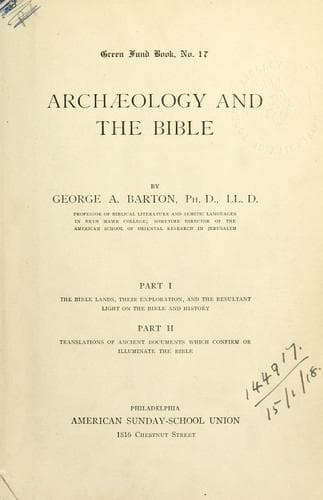
Archæology and the BibleBarton, George A. (George Aaron)
Religion
Archæology and the Bible
Barton, George A. (George Aaron)
Bible -- Antiquities; Egypt -- Antiquities; Middle East -- Antiquities
§ 167. If a man takes a wife and she bears him children and that woman
dies, and after her he takes a second and she bears him children,
after the father dies, the children shall not share according to their
mothers. They shall receive the dowries of their respective mothers,
and the goods of their father’s house they shall share equally.
§ 168. If a man has set his face to cut off his son, and says to the
judges: “I will cut off my son,” the judges shall make investigation
concerning him; if the son has not committed a grave crime which cuts
off from sonship, the father may not cut off his son from sonship.
§ 169. If he has committed against his father a grave crime which cuts
off from sonship, he shall pardon him for the first offense. If he
commits a grave crime the second time, the father may cut off his son
from sonship.
§ 170. If a man’s wife bears him children and a slave-girl bears him
children, and the father during his lifetime says to the children
which the slave-girl bore him: “My children,” and counts them with the
children of the wife, after the father dies the children of the wife
and the children of the slave-girl shall divide equally the goods of
their father’s house. The sons that are sons of the wife shall at the
sharing divide and take.
§ 171. But if the father during his lifetime has not said unto the
children which the slave-girl bore him: “My children,” after the
father dies the children of the slave-girl shall not share with the
children of the wife. The slave-girl and her children shall be given
their freedom; the children of the wife may not put a claim upon the
children of the slave-girl for service. The wife shall receive her
dowry and a gift which her husband gave her and wrote upon a tablet
and may dwell in the dwelling of her husband as long as she lives and
eat. She may not sell it. After her it belongs to her children.
§ 172. If her husband has not given her a gift, they shall restore to
her her dowry and she shall receive from the goods of the house of her
husband the portion of one son. If the children abuse her in order to
drive her from the house, the judges shall investigate concerning her
and if they find the children in the wrong, that woman shall not go
from the house of her husband. If that woman sets her face to go out,
she shall leave with her children the gift which her husband gave her;
the dowry from the house of her father she shall receive and the
husband of her choice may take her.
§ 173. If that woman, where she has entered, bears children to her
later husband, after that woman dies the children of her first and her
later husband shall share her dowry.
§ 174. If she did not bear children to her later husband, the children
of her first husband shall receive her dowry.
Public-domain text, read in full here on John Shaqi.
Reviews
Reviews
No reviews yet
Be the first to share your thoughts on this work.
Elsewhere in the archive
Join the Discussion
Join the discussion
Sign in to leave a comment or review.
Sign InorCreate an account