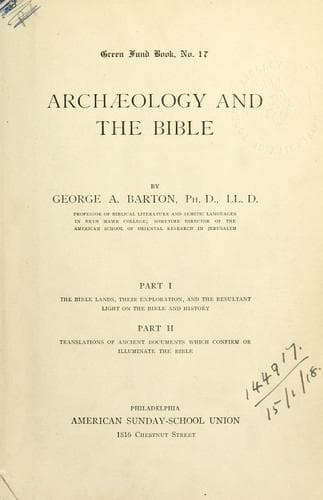
Archæology and the BibleBarton, George A. (George Aaron)
Religion
Archæology and the Bible
Barton, George A. (George Aaron)
Bible -- Antiquities; Egypt -- Antiquities; Middle East -- Antiquities
In the winter of 1905-1906 Petrie, excavating at Tell el-Ye-hudiyeh,[4]
about 20 miles north of Cairo, discovered what he believes to have been
one of the original encampments of the Hyksos in Egypt. This encampment
consisted of a large space, averaging about 1,500 feet in each direction,
surrounded by a wall of sloping sand and mud. This wall, varying from 80
to 140 feet wide at the top and from 130 to 200 feet wide at the bottom,
presented on the outer side a long slope, and is quite unlike any
structure of the native Egyptians. From the nature of the wall and the
small objects found near it, Petrie infers that it was the rampart of a
people who defended themselves with bows and arrows. A cemetery of the
same level yielded to the explorer a considerable amount of black pottery,
not at all like pottery of native Egyptian manufacture, and a number of
crude scarabs. These objects Petrie believes are products of the art of
the Hyksos before they had been in Egypt long enough to adopt Egyptian
civilization. In 1912 Petrie discovered a similar Hyksos camp at the site
of Heliopolis, the Biblical On.
It has been held by many that Abraham, Joseph, and Jacob all went to Egypt
during the reign of the Hyksos dynasty. It would be natural for Semites to
enter such a country, if it were ruled by a dynasty of the same blood as
themselves. Egypt has, however, furnished no positive archæological
evidence of this view. The Semitic names just alluded to, which are
sometimes cited as evidence of it, in reality only prove that many Semites
came with the Hyksos. They make it probable, indeed, that some of the
Hyksos were Semites, but give us no positive evidence concerning the
patriarchs. On the other hand, nothing has been discovered in Egypt to
disprove this view.
(3) _The El-Amarna Letters._--In the winter of 1887-1888 a native Egyptian
woman, according to one account, accidentally discovered some clay tablets
in the soil at Tell el-Amarna, about 200 miles south of Cairo on the east
bank of the Nile. She is said to have sold her rights in the discovery for
about 50 cents. It was thus that nearly four hundred clay tablets,
inscribed in the Babylonian language and characters, which opened an
entirely unknown vista in the history of Palestine and the surrounding
countries, were found. These were letters written to Kings Amenophis III
and Amenophis IV, of the eighteenth dynasty. (See § 6 (7).) Seven of them
were written by Ebed-hepa, King of Jerusalem, about 1360 B. C., and give
us a glimpse of that city more than 350 years before David conquered it
for Israel. Others of the letters came from other cities of Palestine and
Phœnicia, and reveal to us through contemporary documents the conditions
there in the patriarchal age. Some of these are translated in Part II, p.
344, ff.
Public-domain text, read in full here on John Shaqi.
Reviews
Reviews
No reviews yet
Be the first to share your thoughts on this work.
Join the Discussion
Join the discussion
Sign in to leave a comment or review.
Sign InorCreate an account