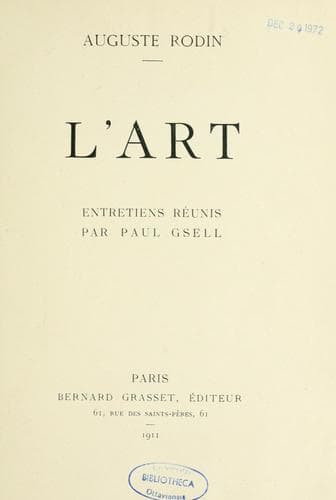
Art; Artists; Artists -- France -- Interviews; Sculpture
“Profession: the tribune. The mouth protrudes like a speaking-trumpet
ready to fling his voice abroad. He lifts his head because, like most
orators, he was short. In this type of man nature develops the chest,
the barrel, at the expense of height. The eyes are not fixed on any one;
they rove over a great assembly. It is a glance at once vague and
superb. Tell me, is it not a marvellous achievement to evoke in this one
head a whole crowd—more, a whole listening country?
“Finally, the individual character. Observe the sensuous lips, the
double chin, the quivering nostrils; you will recognize the faults—habit
of debauch and demand for enjoyment. All is there, I tell you.
“It would be easy to sketch the same character outline from all the
busts of Houdon.
“Here, again, is Franklin. A ponderous air, heavy falling cheeks; this
is the former artisan. The long hair of the apostle, a kindly
benevolence; this is the popular moralizer, good-natured Richard.
“A stubborn high forehead inclined forward, indicative of the obstinacy
of which Franklin gave proof in winning an education, in rising, in
becoming an eminent scholar, finally in freeing his country. Astuteness
in the eyes and in the corners of the mouth; Houdon was not duped by the
general massiveness, and he divined the prudent materialism of the
calculator who made a fortune, and the cunning of the diplomat who
wormed out the secrets of English politics. Here, living, is one of the
ancestors of modern America!
“Well! Here, in these remarkable busts, do we not find the fragmentary
chronicle of half a century? And, as in the finest written narratives,
what pleases most in these memoirs in terra-cotta, in marble and in
bronze, is the brilliant grace of the style, the lightness of the hand
that wrote them, the generosity of this charming personality, so
essentially French, who created them. Houdon is Saint-Simon without his
aristocratic prejudices; is Saint-Simon as witty but more magnanimous.
Ah! what a divine artist!”
“It must be very difficult,” I said, verifying in the busts before us
the interpretation of my companion, “to penetrate so profoundly into the
consciousness of others.”
Public-domain text, read in full here on John Shaqi.
Reviews
Reviews
No reviews yet
Be the first to share your thoughts on this work.
Join the Discussion
Join the discussion
Sign in to leave a comment or review.
Sign InorCreate an account